Dead to Sin, Alive to God Through Christ
Romans 6:5-11 (NLT)
5 Since we have been united with him in his death, we will also be raised to life as he was. 6 We know that our old sinful selves were crucified with Christ so that sin might lose its power in our lives. We are no longer slaves to sin. 7 For when we died with Christ we were set free from the power of sin. 8 And since we died with Christ, we know we will also live with him. 9 We are sure of this because Christ was raised from the dead, and he will never die again. Death no longer has any power over him. 10 When he died, he died once to break the power of sin. But now that he lives, he lives for the glory of God. 11 So you also should consider yourselves to be dead to the power of sin and alive to God through Christ Jesus.
Message
I. United with Christ in death and resurrection (5, 8)
Let me repeat the 1st paragraph from the message last week on Romans 6:1-4:
Paul compared and contrasted Adam and Christ in Romans 5:12–21. We know Adam’s fall resulted in sin and death entering the world and affecting everyone. It is difficult to fully understand, but we see its reality. Adam, as the first man, represented humanity.
When you read this, you can understand why Paul says, ‘we have been united with him in his death’ (5a). The first man (1 Corinthians 15:45, 47), Adam put everyone under the power of sin and death, as though we were united with him. Likewise, the last Adam (1 Corinthians 15:45), Jesus brought a right relationship with God and new life for everyone (Romans 5:18-19, See I. Adam’s Sin and Christ’s Righteousness (18-19) in the message Where Sin Increased, Grace Ruled).
In the light of the above facts or reasoning, we can understand today’s passage.
Just as we are united with Christ in His death (5a), we will also be raised to life as he was (5b).
Verse 8 repeats verse 5.
Since we died with Christ, we know we will also live with him (8). This repeats verse 5.
II. Freed from the power of sin (6-7)
Our old sinful selves were crucified with Christ so that sin might lose its power in our lives (6a). We are no longer slaves to sin (6b). When we died with Christ we were set free from the power of sin (7).
We understand why Paul says, “crucified with Christ” (6) and “died with Christ” (7). This is just as we were represented by Adam in his disobedience.
III. Freed from the power of death (9)
Now Paul focuses on ‘resurrection’ and ‘life’. We are sure of this because Christ was raised from the dead, and he will never die again. Death no longer has any power over him (9).
IV. Dead to Sin, Alive to God (10-11)
When Christ died, he died once to break the power of sin (10a). But now that he lives, he lives for the glory of God (10b). So we also should consider ourselves to be dead to the power of sin and alive to God through Christ Jesus (11).
Amen.
United with Christ in His Death and New Life
Romans 6:1-4 NLT
1 Well then, should we keep on sinning so that God can show us more and more of his wonderful grace? 2 Of course not! Since we have died to sin, how can we continue to live in it? 3 Or have you forgotten that when we were joined with Christ Jesus in baptism, we joined him in his death? 4 For we died and were buried with Christ by baptism. And just as Christ was raised from the dead by the glorious power of the Father, now we also may live new lives.
Message
Paul compared and contrasted Adam and Christ in Romans 5:12–21. We know Adam’s fall resulted in sin and death entering the world and affecting everyone. It is difficult to fully understand, but we see its reality. Adam, as the first man, represented humanity.
Likewise, Christ represented us. Therefore, when Paul says, “when we were joined with Christ Jesus in baptism, we joined him in his death” (v.3), “we died and were buried with Christ by baptism” (v.4a), and “just as Christ was raised from the dead by the glorious power of the Father, now we also may live new lives” (v.4), we can understand that believers are united with Christ. His death became our death to sin, and His resurrection opens the way for us to live a new life.
NOTE: In the passage above, “baptism” is also the word Jesus used to describe His suffering and death in Luke 12:50 (NLT):
“I have a terrible baptism of suffering ahead of me, and I am under a heavy burden until it is accomplished!”
Where Sin Increased, Grace Ruled
Romans 5:18-21 NLT
18 Yes, Adam’s one sin brings condemnation for everyone, but Christ’s one act of righteousness brings a right relationship with God and new life for everyone. 19 Because one person disobeyed God, many became sinners. But because one other person obeyed God, many will be made righteous. 20 God’s law was given so that all people could see how sinful they were. But as people sinned more and more, God’s wonderful grace became more abundant. 21 So just as sin ruled over all people and brought them to death, now God’s wonderful grace rules instead, giving us right standing with God and resulting in eternal life through Jesus Christ our Lord.
Message
I. Adam’s Sin and Christ’s Righteousness (18-19)
Last week, we studied the superiority of Christ’s grace in comparison to Adam’s sin (Romans 5:15-17).
In verse 18, Paul contrasts Adam’s one sin and Christ’s one act of righteousness.
| Actor | Action | Consequences |
| Adam | One sin | Condemnation for everyone |
| Christ | One act of righteousness | A right relationship with God and new life for everyone |
In verse 19, Paul contrasts one person’s disobedience to God and one other person’s obedience to God.
| One actor’s action toward God’s word | Consequences |
| One person’s disobedience to God | Many became sinners |
| One other person’s obedience to God | Many will be made righteous |
II. The Law Revealed Sin (20a)
See verse 20a.
20a God’s law was given so that all people could see how sinful they were.
The law revealed their sin so that they could see how sinful they were (20a).
The law didn’t solve their sin. Instead, it exposed their sin, made their guilt clearer, and showed how much they needed God’s greater grace in Christ (20a, Romans 4:15, 7:5, 7-8, 13).
III. God’s Grace Became More Abundant and Rules Through Christ (20b–21)
See verses 20b and 21.
20b But as people sinned more and more, God’s wonderful grace became more abundant. 21 So just as sin ruled over all people and brought them to death, now God’s wonderful grace rules instead, giving us right standing with God and resulting in eternal life through Jesus Christ our Lord.
Verses 20b and 21 contrast sin and God’s wonderful grace:
| Compared objects | Verse 20b | Verse 21 |
| Sin | Committed by people more and more | Ruled over all people and brought them to death |
| God’s wonderful grace | Became more abundant | Rules instead of sin, giving us right standing with God and resulting in eternal life through Jesus Christ our Lord |
It is God’s wonderful and abundant grace that solves our sin (20b). It gives us right standing with God and results in eternal life through Jesus Christ our Lord (21b).
The Superiority of Christ’s Grace
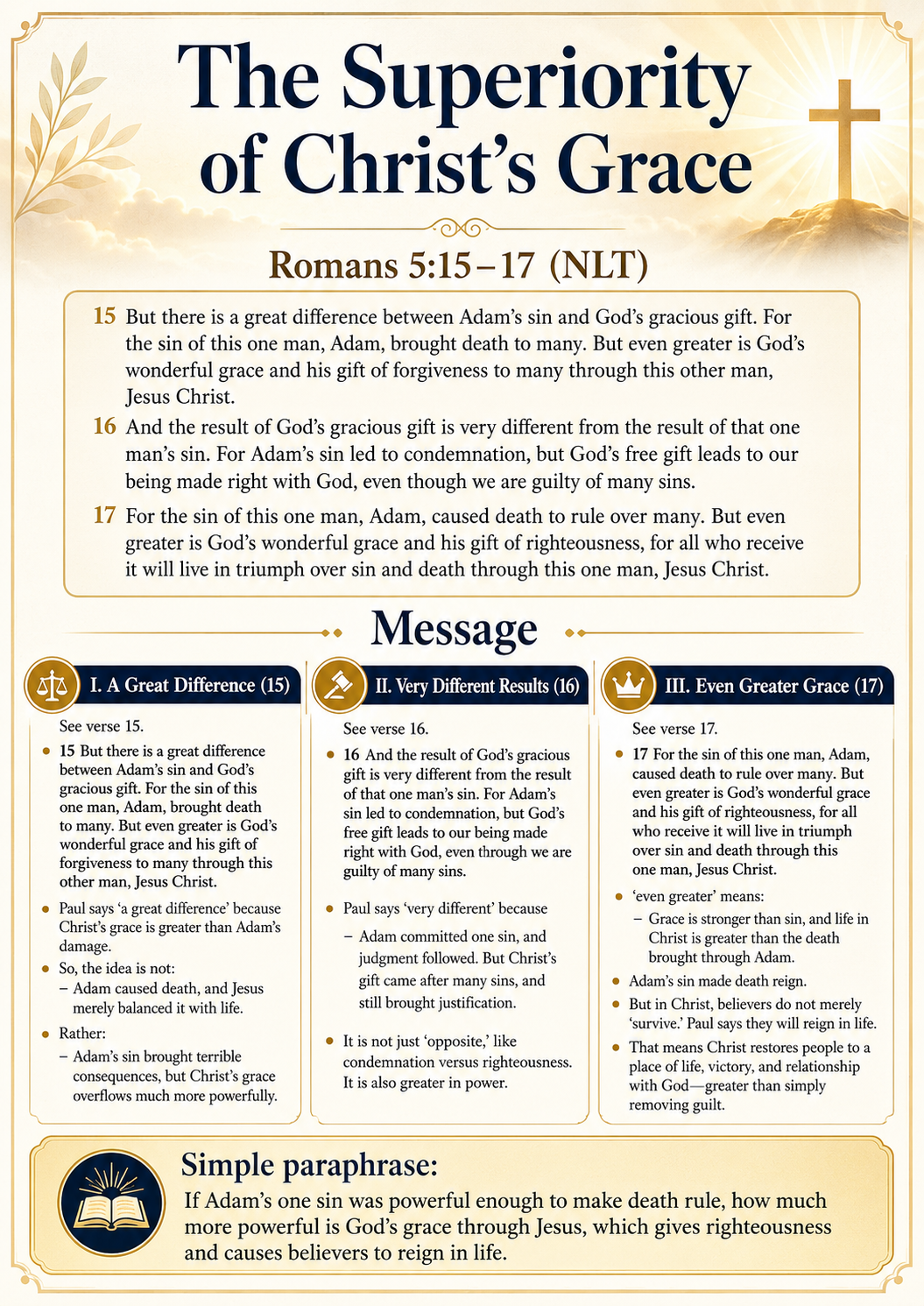
Romans 5:15–17 (NLT)
15 But there is a great difference between Adam’s sin and God’s gracious gift. For the sin of this one man, Adam, brought death to many. But even greater is God’s wonderful grace and his gift of forgiveness to many through this other man, Jesus Christ. 16 And the result of God’s gracious gift is very different from the result of that one man’s sin. For Adam’s sin led to condemnation, but God’s free gift leads to our being made right with God, even though we are guilty of many sins. 17 For the sin of this one man, Adam, caused death to rule over many. But even greater is God’s wonderful grace and his gift of righteousness, for all who receive it will live in triumph over sin and death through this one man, Jesus Christ.
Message
I. A Great Difference (15)
See verse 15.
15 But there is a great difference between Adam’s sin and God’s gracious gift. For the sin of this one man, Adam, brought death to many. But even greater is God’s wonderful grace and his gift of forgiveness to many through this other man, Jesus Christ.
Paul says “a great difference” because Christ’s grace is greater than Adam’s damage.
So, the idea is not:
Adam caused death, and Jesus merely balanced it with life.
Rather:
Adam’s sin brought terrible consequences, but Christ’s grace overflows much more powerfully.
II. Very Different Results (16)
See verse 16.
16 And the result of God’s gracious gift is very different from the result of that one man’s sin. For Adam’s sin led to condemnation, but God’s free gift leads to our being made right with God, even though we are guilty of many sins.
Paul says “very different” because
Adam committed one sin, and judgment followed. But Christ’s gift came after many sins, and still brought justification.
It is not just “opposite,” like condemnation versus righteousness. It is also greater in power.
III. Even Greater Grace (17)
See verse 17.
17 For the sin of this one man, Adam, caused death to rule over many. But even greater is God’s wonderful grace and his gift of righteousness, for all who receive it will live in triumph over sin and death through this one man, Jesus Christ.
“even greater” means:
Grace is stronger than sin, and life in Christ is greater than the death brought through Adam.
Adam’s sin made death reign.
But in Christ, believers do not merely “survive.” Paul says they will reign in life.
That means Christ restores people to a place of life, victory, and relationship with God— greater than simply removing guilt.
Simple paraphrase:
“If Adam’s one sin was powerful enough to make death rule, how much more powerful is God’s grace through Jesus, which gives righteousness and causes believers to reign in life.”
Why Everyone Dies Since Adam’s Fall
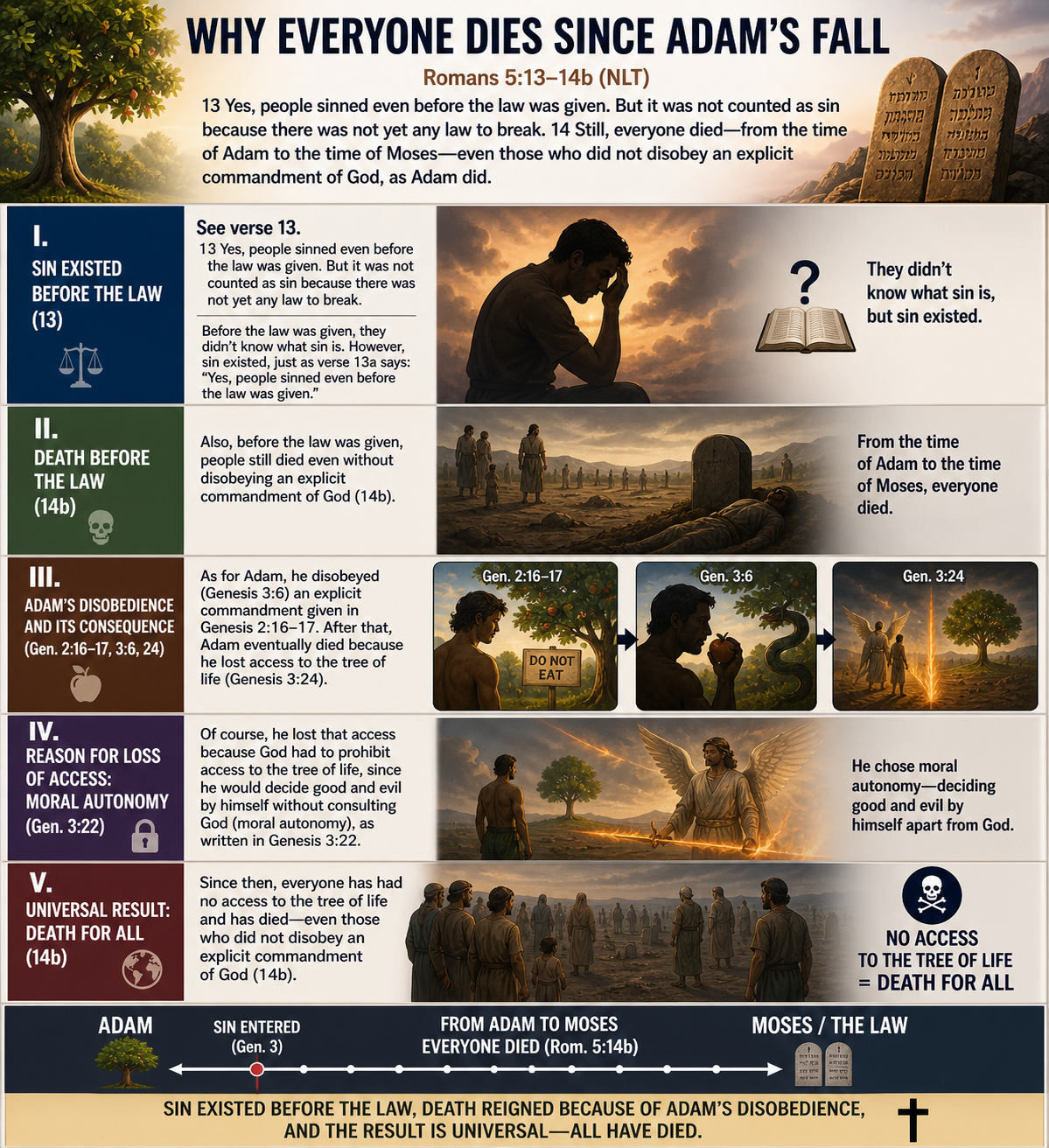
Romans 5:13–14b (NLT)
13 Yes, people sinned even before the law was given. But it was not counted as sin because there was not yet any law to break. 14 Still, everyone died—from the time of Adam to the time of Moses—even those who did not disobey an explicit commandment of God, as Adam did.
Message
I. Sin Existed Before the Law (13)
See verse 13.
13 Yes, people sinned even before the law was given. But it was not counted as sin because there was not yet any law to break.
Before the law was given, they didn’t know what sin is. However, sin existed, just as verse 13a says: “Yes, people sinned even before the law was given.”
II. Death Before the Law (14b)
Also, before the law was given, people still died even without disobeying an explicit commandment of God (14b).
III. Adam’s Disobedience and Its Consequence (Genesis 2:16-17, 3:6, 24)
As for Adam, he disobeyed (Genesis 3:6) an explicit commandment given in Genesis 2:16–17. After that, Adam eventually died because he lost access to the tree of life (Genesis 3:24).
IV. Reason for Loss of Access: Moral Autonomy (Genesis 3:22)
Of course, he lost that access because God had to prohibit access to the tree of life, since he would decide good and evil by himself without consulting God (moral autonomy), as written in Genesis 3:22.
V. Universal Result: Death for All (14b)
Since then, everyone has had no access to the tree of life and has died—even those who did not disobey an explicit commandment of God (14b).
From Adam’s Fall to Enoch’s Walk
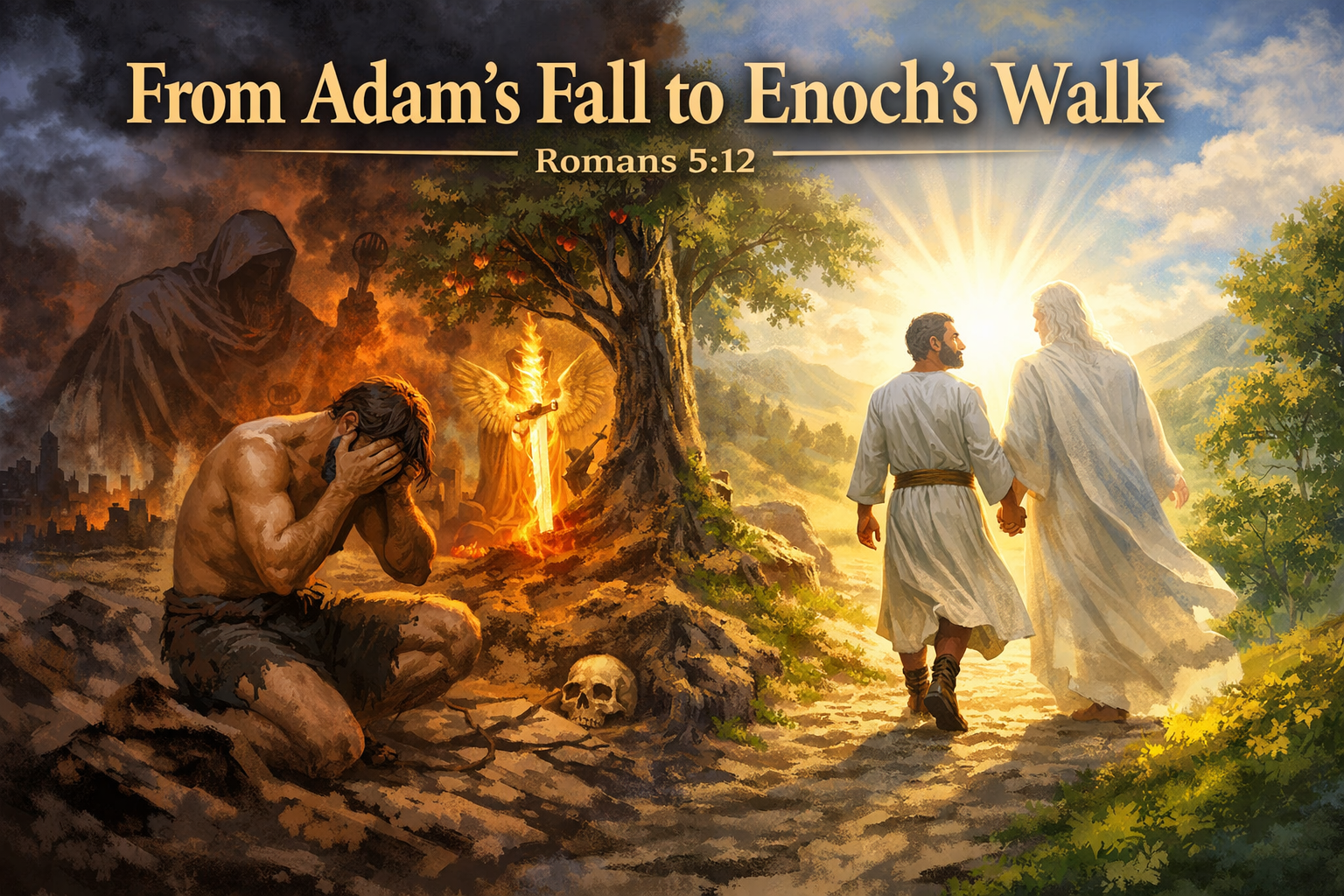
Romans 5:12 (NLT)
12 When Adam sinned, sin entered the world. Adam’s sin brought death, so death spread to everyone, for everyone sinned.
Message
Paul compares and contrasts Adam and Christ in Romans 5:12–17. In fact, Adam is the first man, while Christ is the last Adam (1 Corinthians 15:45). Why are both Adam and Christ called by the same title, “Adam”? It is because of their foundational roles in human history. Each is the first person who began a history—either of death or of life.
Today, let us study Romans 5:12.
I. Adam’s Sin and the Entrance of Death (12)
Paul declares that sin entered the world when Adam sinned (12a). And his sin brought death (12b), as God warned in Genesis 2:16–17 NLT:
16 But the Lord God warned him, “You may freely eat the fruit of every tree in the garden—17 except the tree of the knowledge of good and evil. If you eat its fruit, you are sure to die.”
When God said, “If you eat its fruit, you are sure to die.”, this refers not only to physical death but also to spiritual death. Spiritual death means disconnection from God—a broken relationship caused by rebellion or disobedience.
Now, see verse 12c:
“so death spread to everyone, for everyone sinned.”
After Adam’s sin, Adam’s spiritual & mental condition was corrupted—disobedient and insolent (Genesis 3:22). Therefore, God prohibited their access to the tree of life (Genesis 3:23–24) as shown in Genesis 3:22-24 NLT:
22 Then the Lord God said, “Look, the human beings have become like us, knowing both good and evil. What if they reach out, take fruit from the tree of life, and eat it? Then they will live forever!” 23 So the Lord God banished them from the Garden of Eden, and he sent Adam out to cultivate the ground from which he had been made. 24 After sending them out, the Lord God stationed mighty cherubim to the east of the Garden of Eden. And he placed a flaming sword that flashed back and forth to guard the way to the tree of life.
II. God Sees Enoch’s Unique Faith
While most remained disobedient and insolent before God, Enoch lived in close fellowship with God (Genesis 5:22, 24a), and he was taken by God without experiencing death (Genesis 5:24b; Hebrews 11:5). Enoch is a unique example of faith and a powerful demonstration of God’s care for one who walked closely with Him. God works uniquely in each life. Enoch chose to be obedient and reverent toward God. And God made an exception for him. God could have granted him access to the tree of life, but instead God took him away from the fallen world. Our God is the God who sees (Genesis 16:13; John 4:23; Matthew 18:12; 1 Timothy 2:3–4).
From Helpless Sinners to Reconciled Friends
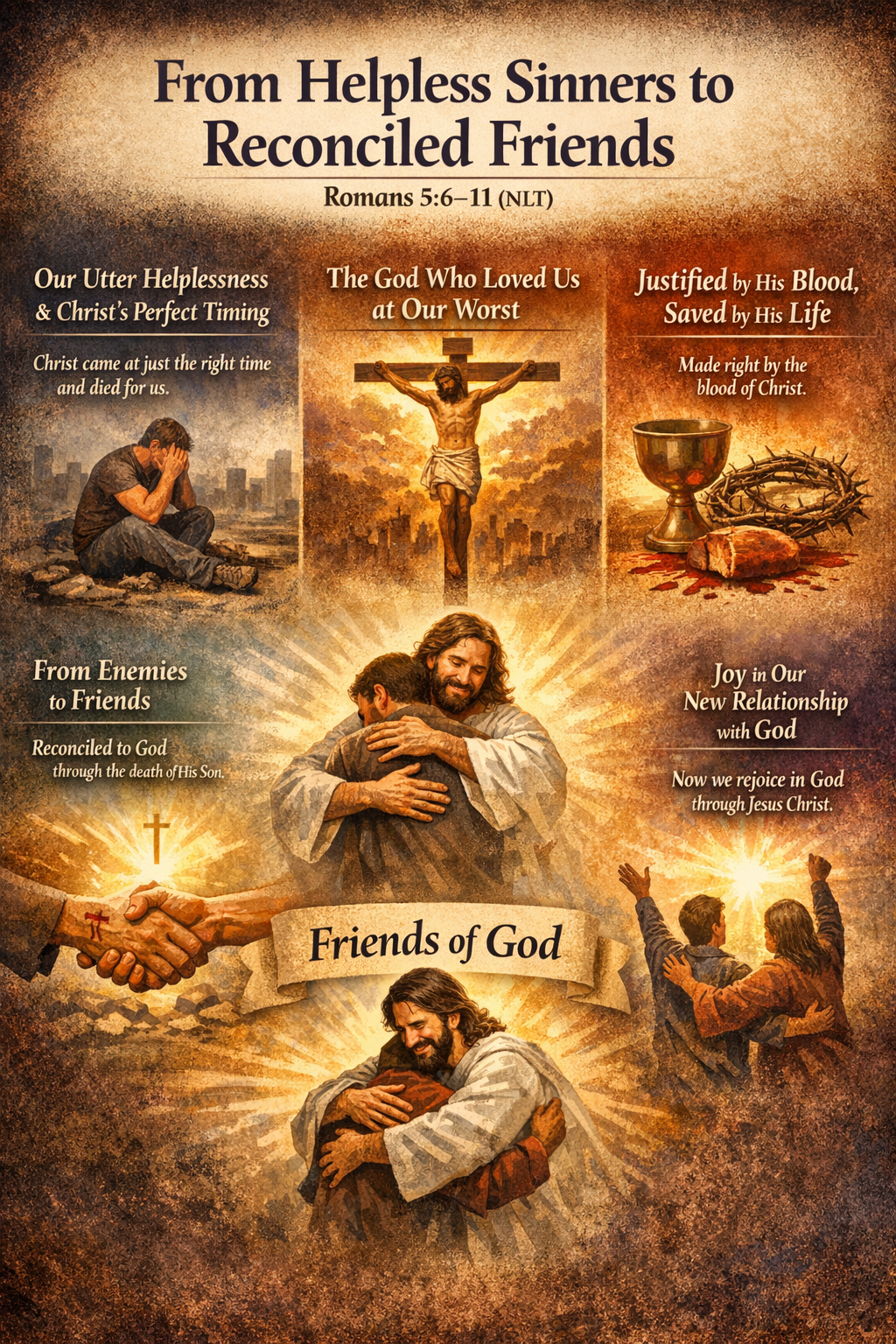
Romans 5:6–11 (NLT)
6 When we were utterly helpless, Christ came at just the right time and died for us sinners. 7 Now, most people would not be willing to die for an upright person, though someone might perhaps be willing to die for a person who is especially good. 8 But God showed his great love for us by sending Christ to die for us while we were still sinners. 9 And since we have been made right in God’s sight by the blood of Christ, he will certainly save us from God’s condemnation. 10 For since our friendship with God was restored by the death of his Son while we were still his enemies, we will certainly be saved through the life of his Son. 11 So now we can rejoice in our wonderful new relationship with God because our Lord Jesus Christ has made us friends of God.
Message
I. Our Utter Helplessness and Christ’s Perfect Timing (6)
See verse 6a.
6a When we were utterly helpless,
The fact that we are utterly helpless is explained in Romans 1:18-3:20.
See verse 6b.
6b Christ came at just the right time and died for us sinners.
In Romans 3:21–4:25, it is explained that people are made right with God by faith in Christ, not by works.
II. The God Who Loved Us at Our Worst (7–8)
To illustrate that God’s love is so great, Paul wrote verses 7 and 8:
Paul explains that most of us are unwilling to die for an upright person, though someone might perhaps be willing to die for an especially good person (7). But God showed His great love for us by sending Christ to die for us while we were still sinners (8).
III. Justified by His Blood, Saved by His Life (9)
More precisely, it was the blood (Leviticus 17:11; Hebrews 9:22) of Christ (1 John 1:7; Romans 3:25) by which we have been made right in God’s sight (9).
IV. The Death That Justifies, the Life That Saves (10)
The restored relationship between God and us was expressed as “friendship” (10a). We were God’s enemies previously (10b). Because the death of His Son restored us from enemies to friends, the life of His Son will certainly save us (10).
V. Joy in the God Who Made Us His Friends (11)
In verse 11, Paul repeats verse 10a-b (11b) and reminds us that we can rejoice in it (11a).
Refined by Trials, Secured by the Spirit
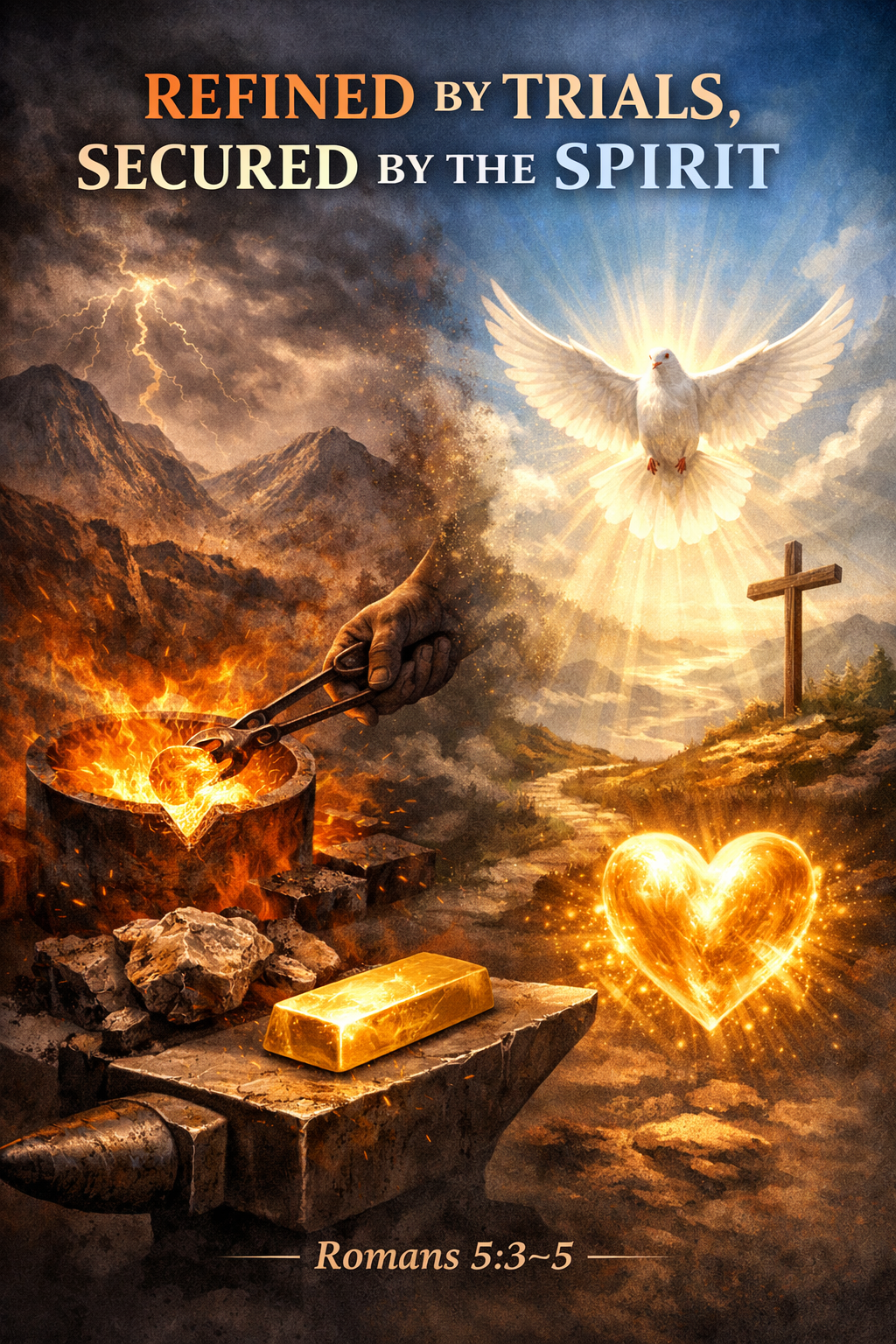
Romans 5:3–5 (NLT)
3 We can rejoice, too, when we run into problems and trials, for we know that they help us develop endurance. 4 And endurance develops strength of character, and character strengthens our confident hope of salvation. 5 And this hope will not lead to disappointment. For we know how dearly God loves us, because he has given us the Holy Spirit to fill our hearts with his love.
Message
Today Paul starts talking about times when we may run into problems and trials (3b). We can rejoice, too, at such time (3a). Paul explains that they help us develop endurance (3c) and qualities that follow (4). Therefore, problems and trials are necessary and are given to us according to God’s good will.
Endurance then develops strength of character (4a). ‘character’ is dokimē in the original text written in Greek, which means
- Proven character
- Tested and approved quality
- Something that has passed the test
It’s not just personality or traits you’re born with. It’s who you become after being tested and refined. We can think of metal refined by fire. Raw metal contains impurities. After refinement, the metal becomes strong, pure and proven. That final result is what Paul calls “character”. 1 Peter 1:6-7 NLT explains this:
6 So be truly glad. There is wonderful joy ahead, even though you must endure many trials for a little while. 7 These trials will show that your faith is genuine. It is being tested as fire tests and purifies gold—though your faith is far more precious than mere gold. So when your faith remains strong through many trials, it will bring you much praise and glory and honor on the day when Jesus Christ is revealed to the whole world.
And character strengthens our confident hope of salvation (4b). And this hope will not lead to disappointment (5a). Paul explains this by pointing to the deposit God has placed in us as a guarantee —the Holy Spirit (5b). This is also explained in 2 Corinthians 1:21-22 NLT:
21 It is God who enables us, along with you, to stand firm for Christ. He has commissioned us, 22 and he has identified us as his own by placing the Holy Spirit in our hearts as the first installment that guarantees everything he has promised us.
This is reflected in Luke 11:13 NLT, where the Holy Spirit is described as the good gift God gives to those who ask Him:
13 So if you sinful people know how to give good gifts to your children, how much more will your heavenly Father give the Holy Spirit to those who ask him.
Therefore, trials are not meaningless—they are God’s way of refining our faith, producing proven character, and leading us into a confident hope that will never disappoint. This hope is secure because God has already given us His Holy Spirit as the guarantee of His love and our salvation.
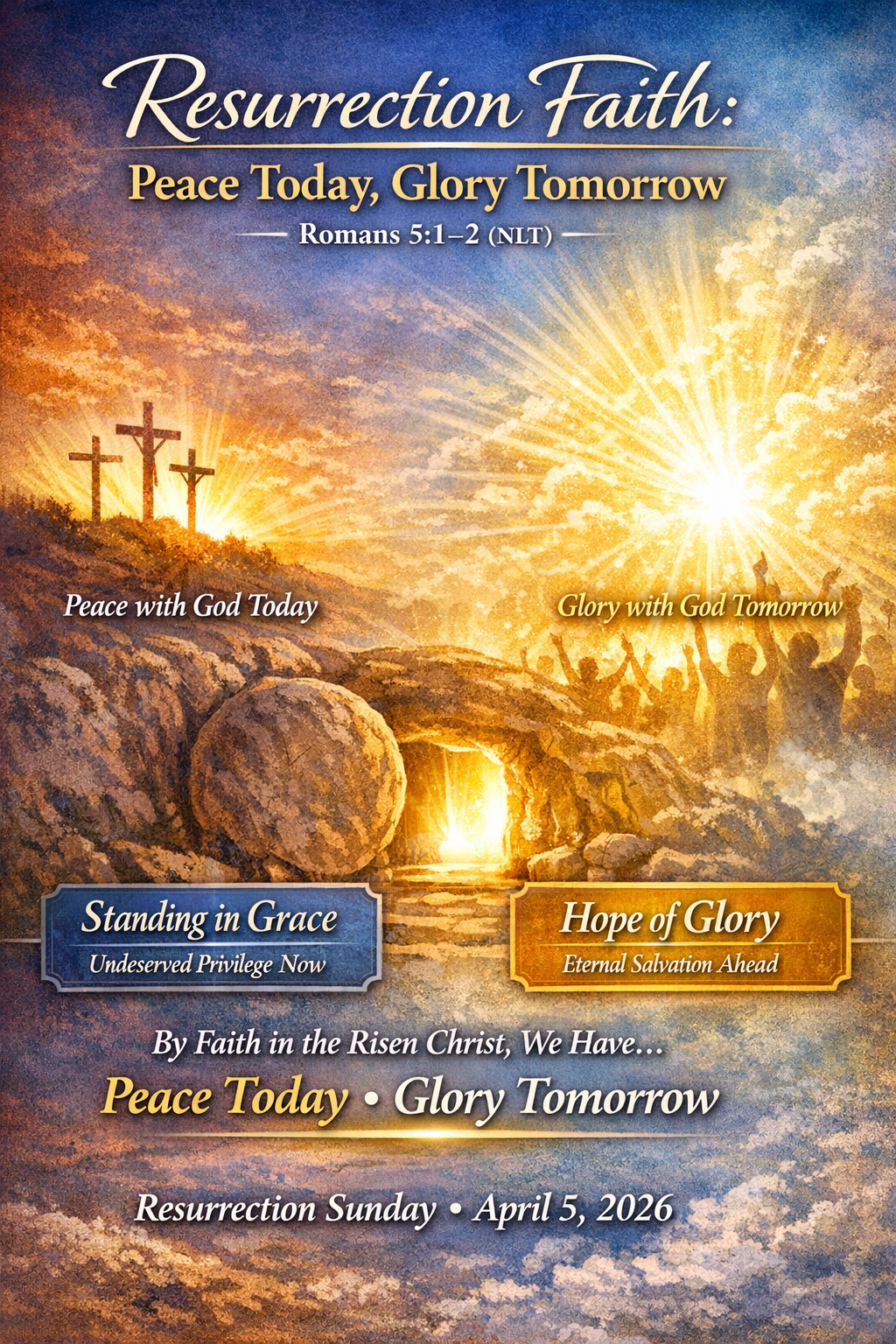
Resurrection Faith: Peace Today, Glory Tomorrow
Romans 5:1–2 (NLT)
1 Therefore, since we have been made right in God’s sight by faith, we have peace with God because of what Jesus Christ our Lord has done for us. 2 Because of our faith, Christ has brought us into this place of undeserved privilege where we now stand, and we confidently and joyfully look forward to sharing God’s glory.
Message
Over the last few weeks, we have studied how faith makes us right with God (Romans 3:21–4:25 NLT).
Abraham was made right with God by believing in ‘what God was going to do’ —that God would give him countless descendants (Genesis 15:5-6). Even as Abraham and Sarah grew old without a child, he believed that God could give life to bodies that were “as good as dead” (Romans 4:17-19). Abraham never wavered in believing God’s promise; instead, his faith grew stronger, and in this he brought glory to God (Romans 4:20 NLT).
As for us, we are made right with God by believing in ‘what God has already done through Christ’ (1). Christ Jesus died, was buried, and on the third day God raised Him back to life (1 Corinthians 15:3-4). Through our faith in His death and resurrection, we have been justified (1).
Romans 5:2 (NLT) tells us that because of our faith, Christ has brought us into:
- this place of undeserved privilege where we now stand (our present standing in grace)
- and we confidently and joyfully look forward to sharing God’s glory (our future salvation and glorification).
Today’s scripture allows us to briefly revisit both Abraham’s faith and our own —faith in the God who raises the dead. And today, on Resurrection Sunday, 5 April 2026, we celebrate the very power that makes our justification, our peace, and our future glory certain.
Happy Resurrection Sunday, everyone!
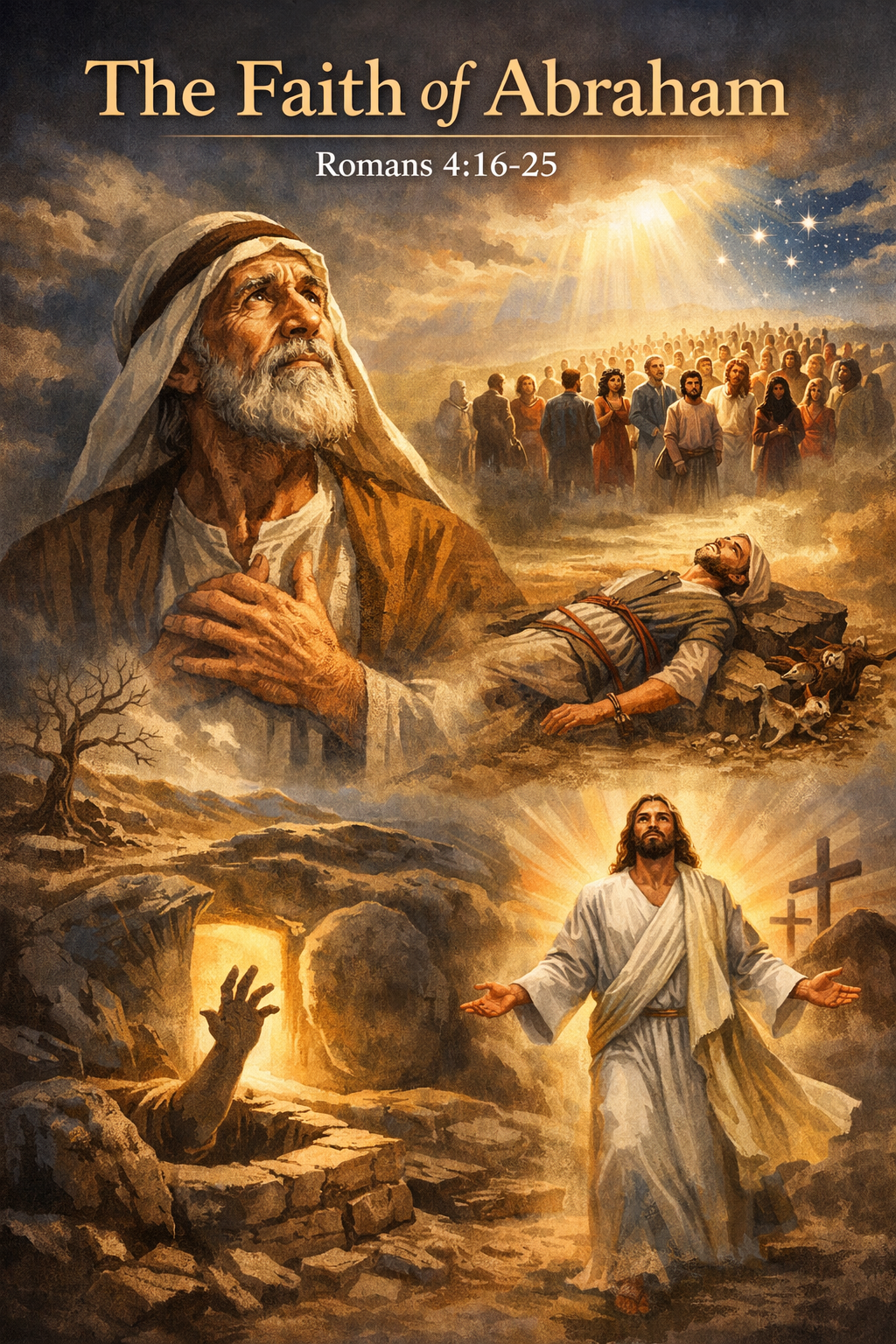
The Faith of Abraham
Romans 4:16–25 (NLT)
16 So the promise is received by faith. It is given as a free gift. And we are all certain to receive it, whether or not we live according to the law of Moses, if we have faith like Abraham’s. For Abraham is the father of all who believe. 17 That is what the Scriptures mean when God told him, “I have made you the father of many nations.” This happened because Abraham believed in the God who brings the dead back to life and who creates new things out of nothing.
18 Even when there was no reason for hope, Abraham kept hoping—believing that he would become the father of many nations. For God had said to him, “That’s how many descendants you will have!” 19 And Abraham’s faith did not weaken, even though, at about 100 years of age, he figured his body was as good as dead—and so was Sarah’s womb.
20 Abraham never wavered in believing God’s promise. In fact, his faith grew stronger, and in this he brought glory to God. 21 He was fully convinced that God is able to do whatever he promises. 22 And because of Abraham’s faith, God counted him as righteous. 23 And when God counted him as righteous, it wasn’t just for Abraham’s benefit. It was recorded 24 for our benefit, too, assuring us that God will also count us as righteous if we believe in him, the one who raised Jesus our Lord from the dead. 25 He was handed over to die because of our sins, and he was raised to life to make us right with God.
Message
I. The Promise Comes by Faith Alone (16)
Last week, we studied “The Promise is by Grace, Not Legal Performance” (Romans 4:13-15 NLT). So, verse 16 summarizes it:
16 So the promise is received by faith. It is given as a free gift. And we are all certain to receive it, whether or not we live according to the law of Moses, if we have faith like Abraham’s. For Abraham is the father of all who believe.
Abraham is not only the father of the Jews but also the spiritual father of all who believe (16; see also Romans 4:11-12 NLT). God told Abraham, “I have made you the father of many nations.” (Genesis 17:5) That is, God promised him not just one nation, Israel, but many nations. This is possible because whoever has faith like Abraham’s is his descendant, regardless of whether he is a Jew or a Gentile (17a).
II. Faith like Abraham’s is this (17-25)
- Abraham believed in the God who brings the dead back to life (19; Hebrews 11:19; Genesis 22) and who creates new things out of nothing (17b).
- Even when there was no reason for hope, Abraham kept hoping—believing that he would become the father of many nations. For God had said to him, “That’s how many descendants you will have!” (18; Genesis 15:5)
- And Abraham’s faith did not weaken, even though, at about 100 years of age, he figured his body was as good as dead—and so was Sarah’s womb (19).
- Abraham never wavered in believing God’s promise. In fact, his faith grew stronger, and in this he brought glory to God (20). He was fully convinced that God is able to do whatever he promises (21).
And because of Abraham’s faith shown above, God counted him as righteous (22). This was recorded (23b) for our benefit, assuring us that God will also count us as righteous if we believe in Him, the one who raised Jesus our Lord from the dead (24). He was handed over to die because of our sins, and He was raised to life to make us right with God (25).
III. Call to Faith
Even though unbelievers are spiritually dead, they can be raised from death and become children of God through faith in Jesus Christ.
And even though believers still have weaknesses, they are covered by His redemption on the cross. As they continue in faith, they grow, and their lives begin to give glory to God.
Therefore, let us live by faith—like Abraham—fully convinced that God will do what He has promised.