God’s Open Arms to Rebellious Israel and His Revelation to the Gentiles

Romans 10:18–21 (NLT)
18 But I ask, have the people of Israel actually heard the message? Yes, they have:
“The message has gone throughout the earth,
and the words to all the world.”
19 But I ask, did the people of Israel really understand? Yes, they did, for even in the time of Moses, God said,
“I will rouse your jealousy through people who are not even a nation.
I will provoke your anger through the foolish Gentiles.”
20 And later Isaiah spoke boldly for God, saying,
“I was found by people who were not looking for me.
I showed myself to those who were not asking for me.”
21 But regarding Israel, God said,
“All day long I opened my arms to them,
but they were disobedient and rebellious.”
Message
Someone should be sent and he/she should tell them the message of the Good News so that they may hear, believe and call (Romans 10:14-15).
However, Psalm 19:1-3 says the heavens and the skies continue to speak without a sound or word and make God known. As a result,
“The message has gone throughout the earth,
and the words to all the world.” (18, Psalm 19:4)
Therefore, the people of Israel should have heard the message. Above all, they even had the written Law of Moses so that they could read, study and understand the message. So, the people of Israel were those who should have heard and understood the message (19a).
However, the people of Israel were disobedient and rebellious even though God opened His arms to them all day long (Isaiah 65:2). They rejected the message of the Good News when they heard it.
On the other hand, the foolish Gentiles heard the message from the heavens and the skies (18, Psalm 19:1-4). They found God and saw God (Isaiah 65:1). They believed the message of the Good News when they heard it.
Jesus taught in John 6:45 (NLT)
As it is written in the Scriptures, ‘They will all be taught by God.’ Everyone who listens to the Father and learns from him comes to me.
Therefore, God foretold through Moses,
“I will rouse your jealousy through people who are not even a nation.
I will provoke your anger through the foolish Gentiles.” (19, Deuteronomy 32:21)
One Lord for All: Calling, Believing, Hearing, Sending
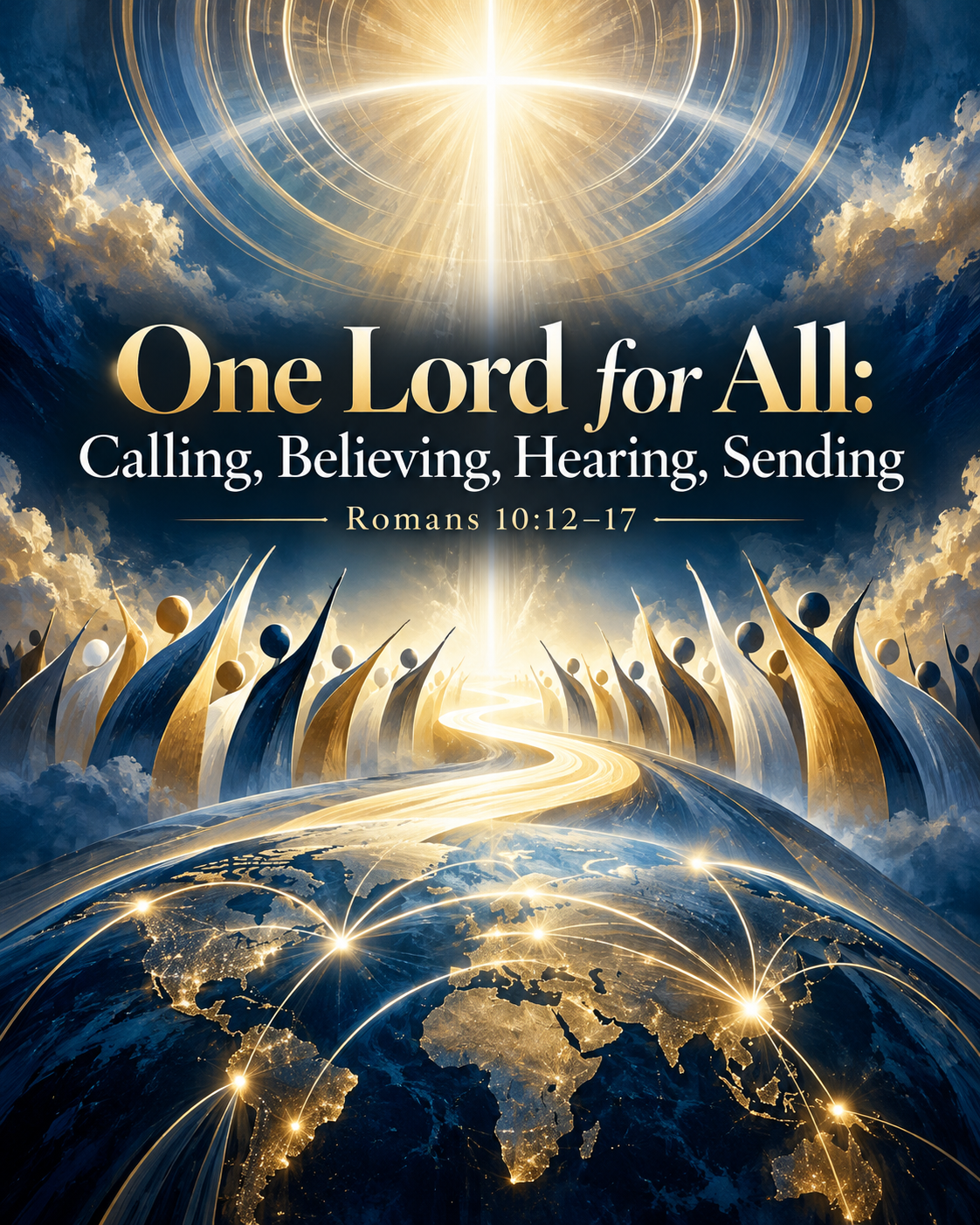
Romans 10:12–17 (NLT)
12 Jew and Gentile are the same in this respect. They have the same Lord, who gives generously to all who call on him. 13 For “Everyone who calls on the name of the Lord will be saved.”
14 But how can they call on him to save them unless they believe in him? And how can they believe in him if they have never heard about him? And how can they hear about him unless someone tells them? 15 And how will anyone go and tell them without being sent? That is why the Scriptures say, “How beautiful are the feet of messengers who bring good news!”
16 But not everyone welcomes the Good News, for Isaiah the prophet said, “Lord, who has believed our message?” 17 So faith comes from hearing, that is, hearing the Good News about Christ.
Message
Both Jew and Gentile can be saved not by the works of the Law, but by believing in Jesus (Romans 3:22–24, 3:28-30, 9:30-32, 10:3-4). Anyone who trusts in him will never be disgraced (Romans 10:11, Isaiah 28:16). Jew and Gentile are the same in this respect. They have the same Lord, who gives generously to all who call on him (12). Everyone who calls on the name of the Lord will be saved (13, Joel 2:32). Believing in Jesus means placing our faith and trust in Him as Lord and Savior, while calling on Jesus means personally turning to Him and appealing to Him for salvation. Paul argues that if no one is sent, no one will go and tell them (15a). Then, no one can hear about Him, no one can believe in Him, and then, no one can call on Him to save them (14). So, how important to take action by sending, going and telling them about the Good News (15b, Isaiah 52:7).
But not everyone welcomes the Good News, for Isaiah the prophet said, “Lord, who has believed our message?” (16, Isaiah 53:1)
Nevertheless, proclaiming the Good News is essential, even though not everyone who hears it will believe. This is because faith comes from hearing, that is, hearing the Good News about Christ (17).
The Message of Faith Is Near: Believe in Your Heart, Confess with Your Mouth

Romans 10:5–11 (NLT)
5 For Moses writes that the law’s way of making a person right with God requires obedience to all of its commands. 6 But faith’s way of getting right with God says, “Don’t say in your heart, ‘Who will go up to heaven?’ (to bring Christ down to earth). 7 And don’t say, ‘Who will go down to the place of the dead?’ (to bring Christ back to life again).” 8 In fact, it says,
“The message is very close at hand;
it is on your lips and in your heart.”
And that message is the very message about faith that we preach: 9 If you openly declare that Jesus is Lord and believe in your heart that God raised him from the dead, you will be saved. 10 For it is by believing in your heart that you are made right with God, and it is by openly declaring your faith that you are saved. 11 As the Scriptures tell us, “Anyone who trusts in him will never be disgraced.”
Message
Moses writes that the law’s way of making a person right with God requires obedience to all of its commands (5). See Leviticus 18:5 NLT:
5 If you obey my decrees and my regulations, you will find life through them. I am the Lord.
See Deuteronomy 30:11-14 NLT:
11 “This command I am giving you today is not too difficult for you, and it is not beyond your reach. 12 It is not kept in heaven, so distant that you must ask, ‘Who will go up to heaven and bring it down so we can hear it and obey?’ 13 It is not kept beyond the sea, so far away that you must ask, ‘Who will cross the sea to bring it to us so we can hear it and obey?’ 14 No, the message is very close at hand; it is on your lips and in your heart so that you can obey it.
The reasons Moses said in Deuteronomy 30:12-13 are written in Deuteronomy 30:11 and 14:
- This command I am giving you today is not too difficult for you, and it is not beyond your reach.
- The message is very close at hand; it is on your lips and in your heart so that you can obey
See verses 6-7:
6 But faith’s way of getting right with God says, “Don’t say in your heart, ‘Who will go up to heaven?’ (to bring Christ down to earth). 7 And don’t say, ‘Who will go down to the place of the dead?’ (to bring Christ back to life again).”
In verses 6-7, Paul applied Deuteronomy 30:12-13 to ‘faith’ rather than to ‘the Law’.
If we apply Deuteronomy 30:14 to ‘faith’ rather than to ‘the Law’, the message is very close at hand; it is on your lips and in your heart (8a) so that you can believe it in your heart and be made right with God and confess your faith with your mouth and be saved (10), where the message is the very message about faith that we preach (8b). See verse 9:
9 If you openly declare that Jesus is Lord and believe in your heart that God raised him from the dead, you will be saved.
Amen.
Verse 11 is quoted from Isaiah 28:16. It was also quoted in Romans 9:33 and 1 Peter 2:6.
“Anyone who trusts in him will never be disgraced.”
Amen.
Misdirected Zeal and God’s Way of Righteousness

Romans 10:1–4 (NLT)
Dear brothers and sisters, the longing of my heart and my prayer to God is for the people of Israel to be saved. 2 I know what enthusiasm they have for God, but it is misdirected zeal. 3 For they don’t understand God’s way of making people right with himself. Refusing to accept God’s way, they cling to their own way of getting right with God by trying to keep the law. 4 For Christ has already accomplished the purpose for which the law was given. As a result, all who believe in him are made right with God.
Message
Today, Paul continues after explaining “Why Israel stumbled, and the Gentiles believed” (Romans 9:30-33).
Paul himself is an Israelite, and he longs and prays for the people of Israel to be saved (1, 1 Timothy 2:3-4). Paul knows their enthusiasm for God, but it is misdirected zeal (2). To help them understand why their zeal is misdirected, Paul has laid the foundation throughout the previous chapters of Romans.
Their problem is written in verse 3:
They don’t understand God’s way of making people right with Himself. Refusing to accept God’s way, they cling to their own way of getting right with God by trying to keep the law.
Then, what is God’s way of making people right with Himself? It is believing in Christ (4b).
Why?
Because Christ has already accomplished the purpose for which the law was given (4a).
Why Israel Stumbled and the Gentiles Believed

Romans 9:30–33 (NLT)
30 What does all this mean? Even though the Gentiles were not trying to follow God’s standards, they were made right with God. And it was by faith that this took place. 31 But the people of Israel, who tried so hard to get right with God by keeping the law, never succeeded. 32 Why not? Because they were trying to get right with God by keeping the law instead of by trusting in him. They stumbled over the great rock in their path. 33 God warned them of this in the Scriptures when he said,
“I am placing a stone in Jerusalem that makes people stumble,
a rock that makes them fall.
But anyone who trusts in him
will never be disgraced.”
Message
Paul describes an ironic situation that the Gentiles, who were not trying to follow God’s standards, were made right with God by faith while the people of Israel, who tried so hard to get right with God by keeping the law, never succeeded (30, 31).
Why not? Paul answers:
Because they were trying to get right with God by keeping the law instead of by trusting in him. They stumbled over the great rock in their path (32). This was foretold in Isaiah 8:14 and 28:16.
Isaiah 8:14 (NLT)
14 He will keep you safe.
But to Israel and Judah
he will be a stone that makes people stumble,
a rock that makes them fall.
And for the people of Jerusalem
he will be a trap and a snare.
Isaiah 28:16 (NLT)
16 Therefore, this is what the Sovereign Lord says:
“Look! I am placing a foundation stone in Jerusalem,
a firm and tested stone.
It is a precious cornerstone that is safe to build on.
Whoever believes need never be shaken.
Israel stumbled because they sought righteousness through the law instead of trusting in the One God had placed in Zion. The stone meant to be their foundation became a stumbling stone. But the same stone is a firm and tested cornerstone for all who believe. Whoever trusts in Him will never be disgraced.
God’s Sovereign Purpose in Mercy and Hardening
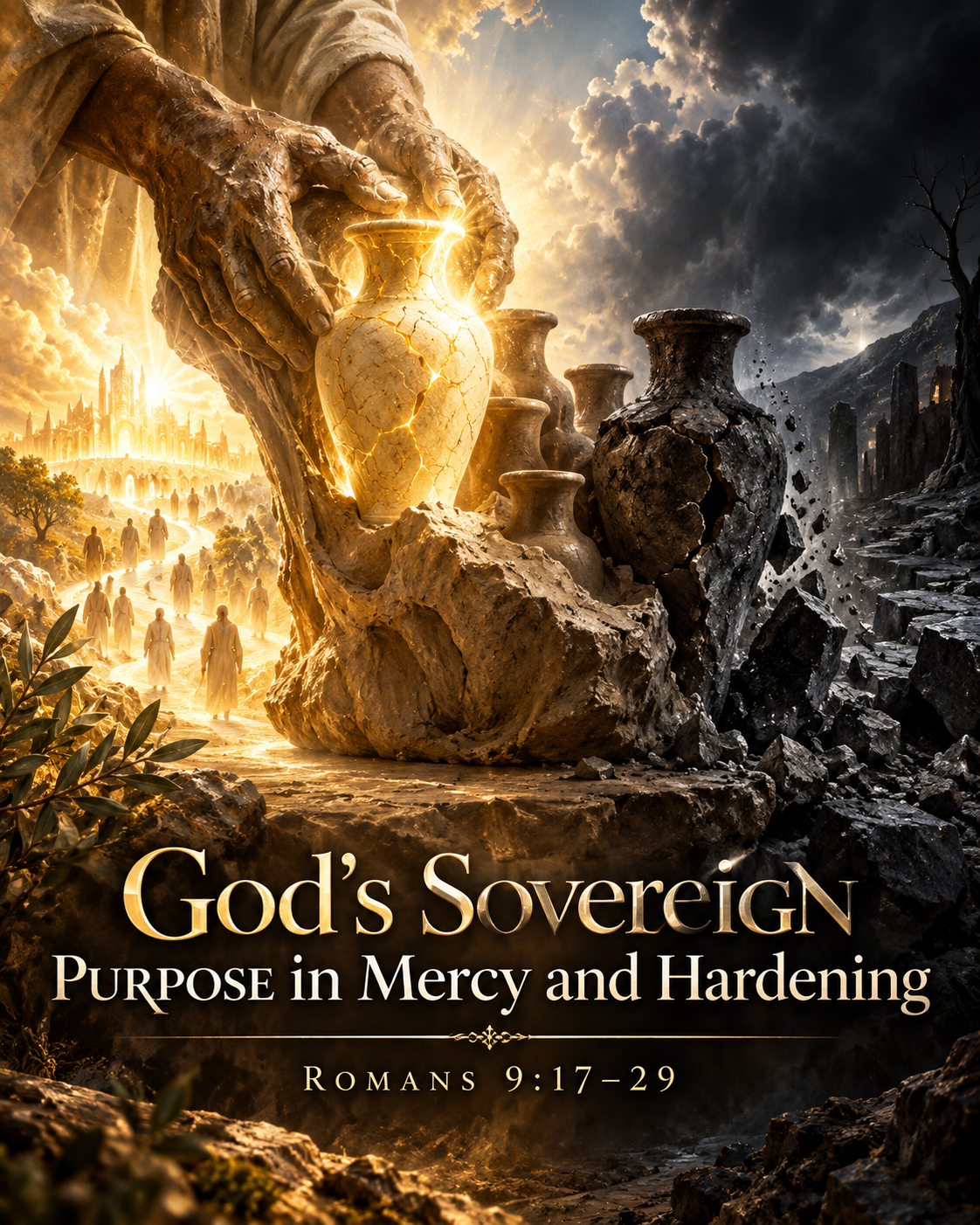
Romans 9:17–29 (NLT)
17 For the Scriptures say that God told Pharaoh, “I have appointed you for the very purpose of displaying my power in you and to spread my fame throughout the earth.” 18 So you see, God chooses to show mercy to some, and he chooses to harden the hearts of others so they refuse to listen.
19 Well then, you might say, “Why does God blame people for not responding? Haven’t they simply done what he makes them do?”
20 No, don’t say that. Who are you, a mere human being, to argue with God? Should the thing that was created say to the one who created it, “Why have you made me like this?” 21 When a potter makes jars out of clay, doesn’t he have a right to use the same lump of clay to make one jar for decoration and another to throw garbage into? 22 In the same way, even though God has the right to show his anger and his power, he is very patient with those on whom his anger falls, who are destined for destruction. 23 He does this to make the riches of his glory shine even brighter on those to whom he shows mercy, who were prepared in advance for glory. 24 And we are among those whom he selected, both from the Jews and from the Gentiles.
25 Concerning the Gentiles, God says in the prophecy of Hosea,
“Those who were not my people,
I will now call my people.
And I will love those
whom I did not love before.”
26 And,
“Then, at the place where they were told,
‘You are not my people,’
there they will be called
‘children of the living God.’ ”
27 And concerning Israel, Isaiah the prophet cried out,
“Though the people of Israel are as numerous as the sand of the seashore,
only a remnant will be saved.
28 For the Lord will carry out his sentence upon the earth
quickly and with finality.”
29 And Isaiah said the same thing in another place:
“If the Lord of Heaven’s Armies
had not spared a few of our children,
we would have been wiped out like Sodom,
destroyed like Gomorrah.”
Message
Last week, we studied “God’s Sovereign Mercy” in Romans 9:10-16. Today let us continue studying on God’s sovereignty. See verse 17.
17 For the Scriptures say that God told Pharaoh, “I have appointed you for the very purpose of displaying my power in you and to spread my fame throughout the earth.”
This is written in Exodus 9:16. So, God not only make sovereign choice to show mercy to some but also make sovereign choice to harden the hearts of others so they refuse to listen (18). Then, we could raise a question, “Why does God blame people for not responding? Haven’t they simply done what he makes them do?” (19)
God is the Creator, and we are His creation; therefore, we are not in a position to accuse Him of injustice for carrying out His sovereign purpose. Like a potter with clay, God has the right to deal differently with people while showing both His justice and His mercy. (20-23)
The heart of some, including some Jews was hardened and refused Jesus (28-29, Isaiah 1:9, 10:22-23) while some Jews (27, Isaiah 10:22) and some Gentiles were chosen by God (24-26, Hosea 2:23, 1:10).
Is God Unfair? God’s Sovereign Mercy
Romans 9:10–16 (NLT)
10 This son was our ancestor Isaac. When he married Rebekah, she gave birth to twins. 11 But before they were born, before they had done anything good or bad, she received a message from God. (This message shows that God chooses people according to his own purposes; 12 he calls people, but not according to their good or bad works.) She was told, “Your older son will serve your younger son.” 13 In the words of the Scriptures, “I loved Jacob, but I rejected Esau.”
14 Are we saying, then, that God was unfair? Of course not! 15 For God said to Moses,
“I will show mercy to anyone I choose,
and I will show compassion to anyone I choose.”
16 So it is God who decides to show mercy. We can neither choose it nor work for it.
Message
This son in verse 10 is Isaac, the son God promised Abraham (Romans 9:9, Genesis 18:10, 14). Isaac married Rebekah, and she was pregnant with twins (Genesis 25:21). Then, Rebekah received a message from God, “Your older son will serve your younger son.” (12b, Genesis 25:23b), before they were born, before they had done anything good or bad (11a). This shows that God chooses people according to His own purpose (11b), but not according to their good or bad works (12a). God loved Jacob, but He rejected Esau (13, Malachi 1:2-3).
Then, was God unfair (14a)? Certainly, He is not unfair (14b). That is, God has not wronged Esau. Because God said to Moses, “I will show mercy to anyone I choose, and I will show compassion to anyone I choose.” (15, Exodus 33:19) So, it is God who decides to show mercy. We can neither choose it nor work for it (16).
In Jesus’ parable, a landowner paid the same wage to all the workers, even though some had worked all day and others were hired near the end of the day (Matthew 20:11–12). Those who worked all day could think it was unfair, but the landowner has not wronged them. They received a day’s wage as promised (Matthew 20:13). The landowner simply chose to be merciful and generous to those who were hired late (Matthew 20:14). He had the right to do so (Matthew 20:15).
Children of the Promise: True Descendants of Abraham
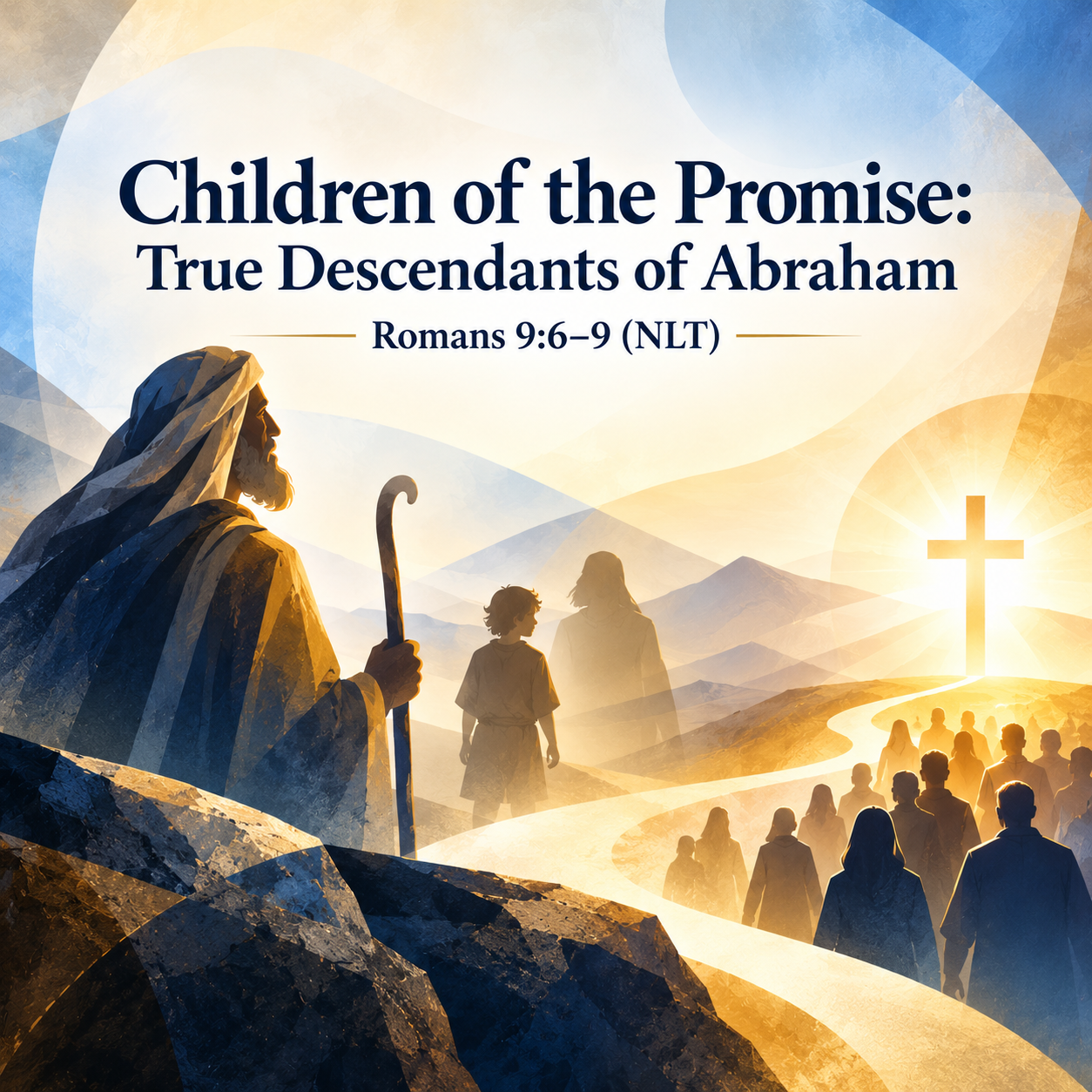
Romans 9:6–9 (NLT)
6 Well then, has God failed to fulfill his promise to Israel? No, for not all who are born into the nation of Israel are truly members of God’s people! 7 Being descendants of Abraham doesn’t make them truly Abraham’s children. For the Scriptures say, “Isaac is the son through whom your descendants will be counted,” though Abraham had other children, too. 8 This means that Abraham’s physical descendants are not necessarily children of God. Only the children of the promise are considered to be Abraham’s children. 9 For God had promised, “I will return about this time next year, and Sarah will have a son.”
Message
Abraham had a child named Ishmael through Sarah’s maid named Hagar (Genesis 16:1-4, 15-16). He had other children after Sarah died (Genesis 25:1-6). But, God said to him, “Isaac is the son through whom your descendants will be counted.” (7b; Genesis 17:19, 21, 21:12)
This means that Abraham’s physical descendants are not necessarily children of God. Only the children of the promise are considered to be Abraham’s children. (8) Not all who are born into the nation of Israel are truly members of God’s people! (6b)
Isaac is called the child of the promise because God had promised, “I will return about this time next year, and Sarah will have a son.” (9; Genesis 18:10, 14)
God promised Joseph the birth of Jesus (Matthew 1:20-23). God promised Mary the birth of Jesus (Luke 1:28-38). God promised Zechariah the birth of John the Baptist (Luke 1: 11-20). God promised Isaac, Jacob, Samson, Samuel, Solomon, Josiah, and Cyrus.
Moreover, God promised those who receive Christ a spiritual rebirth, through which they become children of God (John 1:12–13). They are truly descendants of Abraham, who is the spiritual father of all who believe.
Paul’s Heartbroken Love for Israel
Romans 9:1–5 (NLT)
1 With Christ as my witness, I speak with utter truthfulness. My conscience and the Holy Spirit confirm it. 2 My heart is filled with bitter sorrow and unending grief 3 for my people, my Jewish brothers and sisters. I would be willing to be forever cursed—cut off from Christ!—if that would save them. 4 They are the people of Israel, chosen to be God’s adopted children. God revealed his glory to them. He made covenants with them and gave them his law. He gave them the privilege of worshiping him and receiving his wonderful promises. 5 Abraham, Isaac, and Jacob are their ancestors, and Christ himself was an Israelite as far as his human nature is concerned. And he is God, the one who rules over everything and is worthy of eternal praise! Amen.
Message
Paul declares that what he is about to say is utterly truthful and confirmed by his conscience and the Holy Spirit (1). See verse 2–3.
2 My heart is filled with bitter sorrow and unending grief 3 for my people, my Jewish brothers and sisters. I would be willing to be forever cursed—cut off from Christ!—if that would save them.
Paul’s sorrow and grief for his people, his Jewish brothers and sisters, are due to their unbelief and rejection of Christ. They are supposedly physically more qualified for salvation as descendants of Abraham (4-5). He even would give up his salvation if that could save his people (3). This shows how much he loves them.
Physically and historically, they are the people of Israel who were chosen to be God’s adopted children. God revealed His glory to them. God made covenants with them and gave them His law. God gave them the privilege of worshiping Him and receiving His wonderful promises. (4)
Abraham, Isaac, and Jacob are their ancestors. Christ Himself was an Israelite as far as His human nature is concerned. He is God, the one who rules over everything and is worthy of eternal praise! Amen. (5)
Nothing Can Separate Us from God’s Love: Overwhelming Victory Through Christ

Romans 8:35–39 (NLT)
35 Can anything ever separate us from Christ’s love? Does it mean he no longer loves us if we have trouble or calamity, or are persecuted, or hungry, or destitute, or in danger, or threatened with death? 36 (As the Scriptures say, “For your sake we are killed every day; we are being slaughtered like sheep.”) 37 No, despite all these things, overwhelming victory is ours through Christ, who loved us.
38 And I am convinced that nothing can ever separate us from God’s love. Neither death nor life, neither angels nor demons, neither our fears for today nor our worries about tomorrow—not even the powers of hell can separate us from God’s love. 39 No power in the sky above or in the earth below—indeed, nothing in all creation will ever be able to separate us from the love of God that is revealed in Christ Jesus our Lord.
Message
I. Recap Romans 8:1-34 NLT
i. The Wonderful Things God Has Done (Romans 8:1-30 NLT)
God has done the wonderful things (Romans 8:31 NLT), as written in Romans 8:1-30 NLT.
The Holy Spirit prays for us with groanings that cannot be expressed in words (Romans 8:26 NLT), with perfect intercession (Romans 8:27 NLT) and perfect providence (Romans 8:28 NLT).
God knew His people in advance, chose them to become like His Son, called them to come to Him, gave them right standing with Himself, and gave them His glory (Romans 8:29-30 NLT).
ii. The Unshakeable Security We Have in Christ (Romans 8:31–34 NLT)
Paul exclaimed, “If God is for us, who can ever be against us?” (Romans 8:31b NLT)
- The Father’s Gift guarantees every other gift (Romans 8:32 NLT).
- No accusation against God’s chosen (Romans 8:33 NLT).
- No condemnation because Christ intercedes (Romans 8:34 NLT).
II. Nothing Can Separate Us from the Love of God in Christ (35-39)
i. No Separation Even in Suffering — Overwhelming Victory (35–37)
See verse 35a:
35a Can anything ever separate us from Christ’s love?
Possible situations like this: trouble, calamity, persecution, hunger, destitution, danger, or threat of death—does it mean He no longer loves us if we are experiencing anything like that? (35b)
In verse 36, Paul quotes Psalm 44:22 NLT:
22 But for your sake we are killed every day;
we are being slaughtered like sheep.
In verse 37a, Paul’s answer to verse 35’s question is “No.”
Despite all these things, overwhelming victory is ours through Christ, who loved us (37b).
We are secure in His love, and in the end, we will experience overwhelming victory through Christ.
ii. Nothing in All Creation Can Separate Us from God’s Love in Christ (38–39)
Paul is convinced that nothing can ever separate us from the love of God (38a, 39a) that is revealed in Christ Jesus our Lord (39b).
- Neither death nor life,
- neither angels nor demons,
- neither our fears for today nor our worries about tomorrow
- not even the powers of hell
can separate us from God’s love (38b).
Christ Himself was falsely accused (Matthew 26:59–60), betrayed (Matthew 26:47–49), arrested (Matthew 26:50, 57), abandoned by His disciples (Matthew 26:56), mocked and spat upon (Matthew 26:67–68), slapped (John 18:22), beaten with fists (Matthew 26:67; Mark 14:65), denied by Peter (Matthew 26:69–75), scourged/whipped (Matthew 27:26; John 19:1), crowned with thorns (Matthew 27:29; John 19:2), mocked and struck again (Matthew 27:29–30; John 19:3), forced toward the place of crucifixion (John 19:17; cf. Matthew 27:32), stripped (Matthew 27:28, 35), crucified (Matthew 27:35; John 19:18), insulted while on the cross (Matthew 27:39–44), and died (Matthew 27:50; John 19:30).
However, He was gloriously raised from the dead (Matthew 28:5–6; Acts 2:24), exalted to the right hand of the Father in heaven (Acts 2:33; Romans 8:34; Hebrews 1:3), and revealed as the King of all kings and Lord of all lords (1 Timothy 6:15; Revelation 19:16).
Therefore, because nothing can separate us from God’s love in Christ, our final destiny is not defeat but overwhelming victory through Him.