Justified by Faith Alone: The End of Boasting and the Law’s True Fulfillment
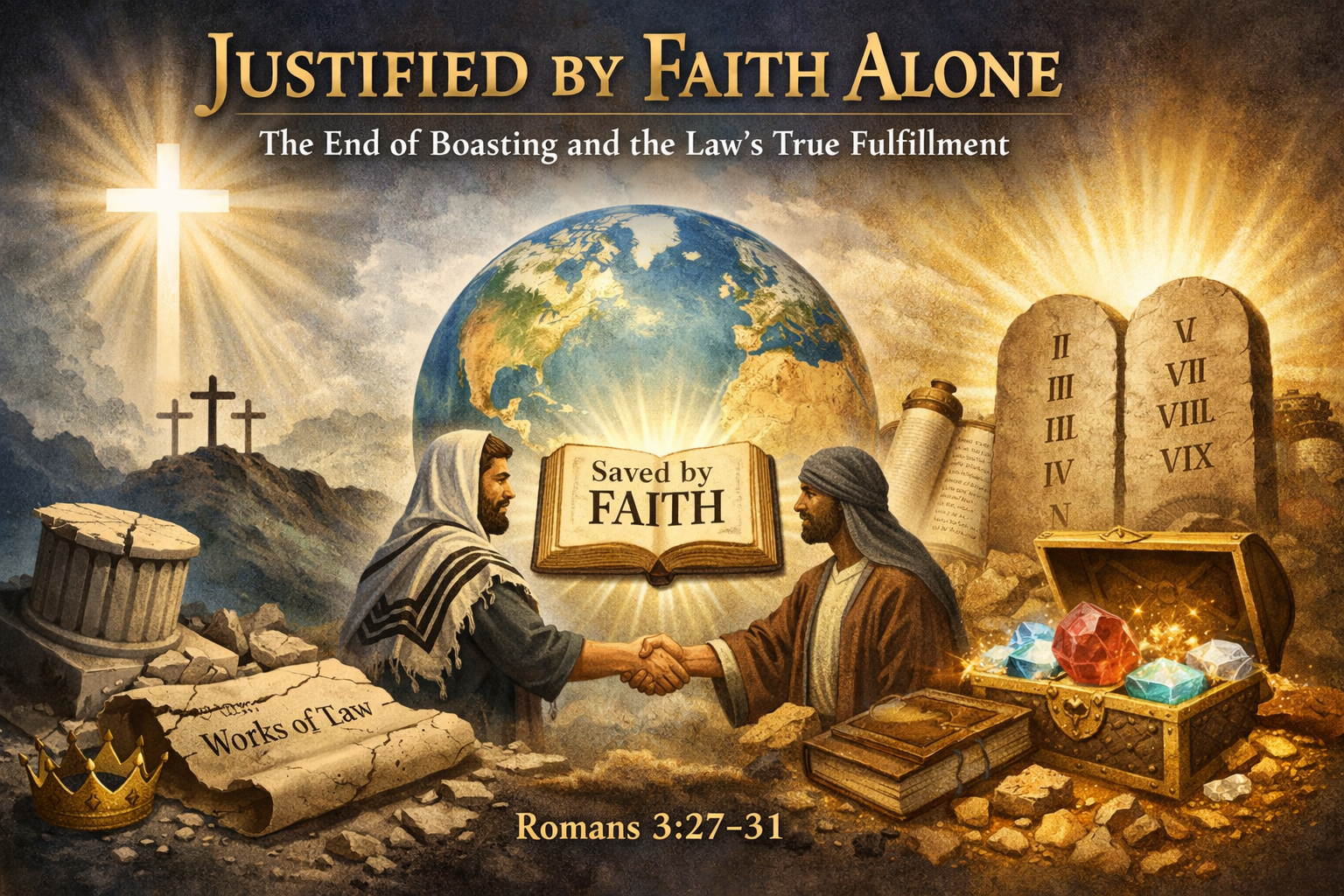
Romans 3:27–31 (NLT)
27 Can we boast, then, that we have done anything to be accepted by God? No, because our acquittal is not based on obeying the law. It is based on faith. 28 So we are made right with God through faith and not by obeying the law.
29 After all, is God the God of the Jews only? Isn’t he also the God of the Gentiles? Of course he is. 30 There is only one God, and he makes people right with himself only by faith, whether they are Jews or Gentiles. 31 Well then, if we emphasize faith, does this mean that we can forget about the law? Of course not! In fact, only when we have faith do we truly fulfill the law.
Message
I. The End of Boasting: Justified by Faith, Not by Works (27–28)
See verse 27a.
27a Can we boast, then, that we have done anything to be accepted by God?
To answer this question, we need to read Romans 3:23-26. Since all have sinned and cannot save themselves, and since we are justified freely by God’s grace through faith in Christ’s sacrifice — not by works of obeying the law — there is no room for human boasting. Verse 27b answers this question:
27b No, because our acquittal is not based on obeying the law. It is based on faith.
Verse 28 presents the conclusion of the question and answer in verse 27. We are justified by faith, not by works of the law.
Faith excludes pride because salvation is entirely God’s work.
II. One God, One Way: All Are Justified by Faith (29–30)
Both the Jews and the Gentiles are made right with God only by faith (29, 30). The gospel unites all people under one gracious principle: faith alone.
III. Faith Establishes the Law: The Law’s True Fulfillment (31)
Then, we have a question. See verse 31a.
31a Well then, if we emphasize faith, does this mean that we can forget about the law?
The answer is written in verse 31b.
31b Of course not! In fact, only when we have faith do we truly fulfill the law.
Faith does not abolish the law. Faith establishes its true purpose.
Jesus gave us relevant lessons as follows:
Matthew 5:17–19 (NLT)
17 “Don’t misunderstand why I have come. I did not come to abolish the law of Moses or the writings of the prophets. No, I came to accomplish their purpose. 18 I tell you the truth, until heaven and earth disappear, not even the smallest detail of God’s law will disappear until its purpose is achieved. 19 So if you ignore the least commandment and teach others to do the same, you will be called the least in the Kingdom of Heaven. But anyone who obeys God’s laws and teaches them will be called great in the Kingdom of Heaven.
Jesus did not come to abolish the Law, but to accomplish its purpose.
Matthew 13:52 (NLT)
52 Then he added, “Every teacher of religious law who becomes a disciple in the Kingdom of Heaven is like a homeowner who brings from his storeroom new gems of truth as well as old.”
Here, old gems mean the truths revealed in the Old Testament. New gems mean the truths revealed in Jesus and His Kingdom. The Old Testament remains a treasure. Jesus and His Kingdom bring its fulfillment and fuller revelation. A mature disciple integrates both.
To understand this — that believers receive the Holy Spirit and therefore fulfill the Law not merely by literal observance but by walking according to the Spirit — we must understand the work of the Holy Spirit.
Read John 16:13–15 (NLT).
The relevant message can be found here:
https://www.comnc.org/the-role-of-the-holy-spirit-and-persecution-foretold/
A related song based on John 16:13–15, The Spirit of Truth, is available on streaming platforms:
https://push.fm/fl/m6nhptlv