John the Baptist’s Message and Practical Guidance
Luke 3:7-14
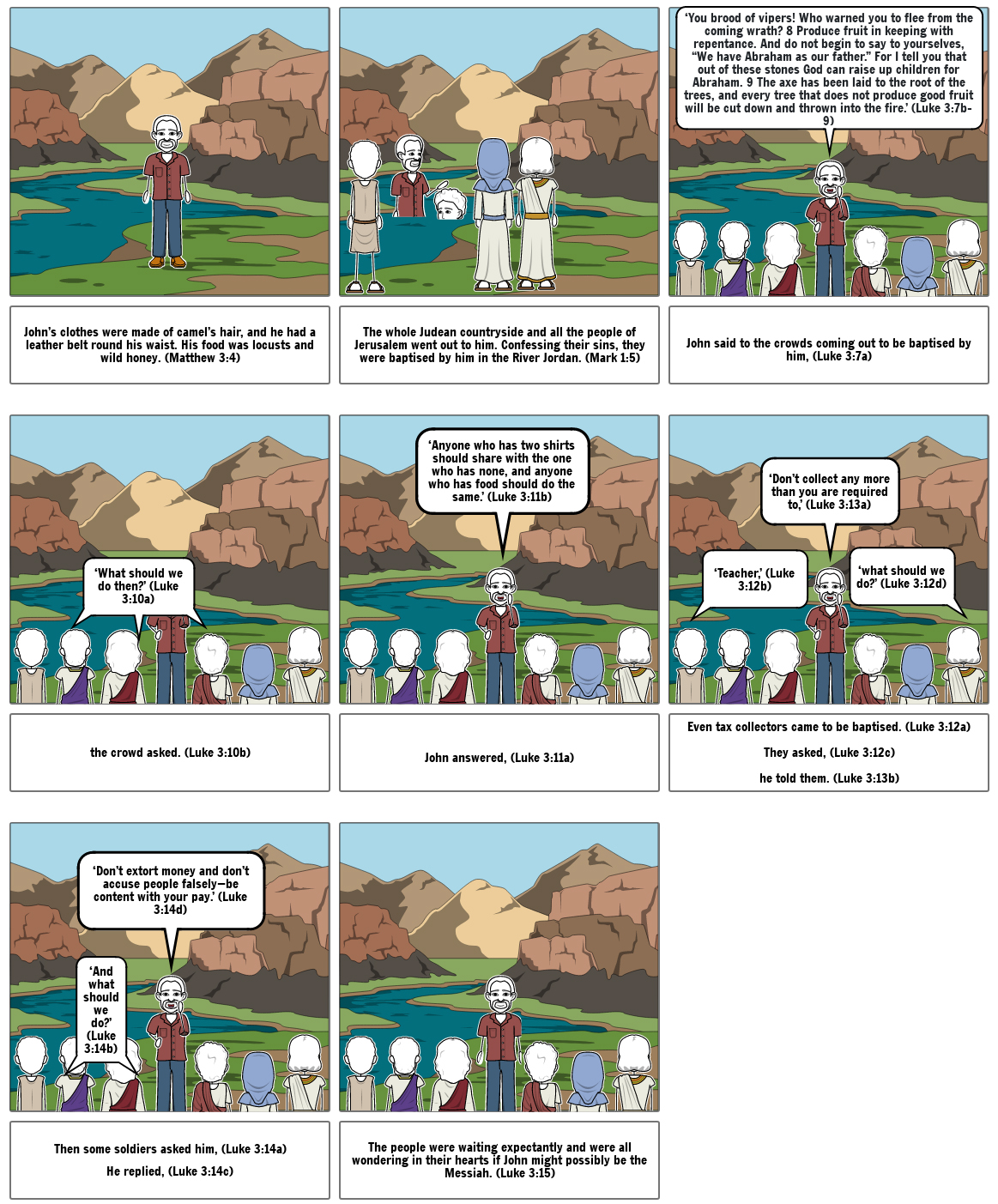
7 John said to the crowds coming out to be baptised by him, ‘You brood of vipers! Who warned you to flee from the coming wrath? 8 Produce fruit in keeping with repentance. And do not begin to say to yourselves, “We have Abraham as our father.” For I tell you that out of these stones God can raise up children for Abraham. 9 The axe has been laid to the root of the trees, and every tree that does not produce good fruit will be cut down and thrown into the fire.’
10 ‘What should we do then?’ the crowd asked.
11 John answered, ‘Anyone who has two shirts should share with the one who has none, and anyone who has food should do the same.’
12 Even tax collectors came to be baptised. ‘Teacher,’ they asked, ‘what should we do?’
13 ‘Don’t collect any more than you are required to,’ he told them.
14 Then some soldiers asked him, ‘And what should we do?’
He replied, ‘Don’t extort money and don’t accuse people falsely—be content with your pay.’
Today, let us study Luke 3:7-14.
Luke 3:7-9 is parallel to Matthew 3:7-10. But Luke 3:7-9 was spoken to the crowds and Matthew 3:7-10 to the Pharisees and Sadducees.
The subsequent verses (Luke 3:10-14) are written only in Luke and give practical guidance for true repentance.
I. John’s Message (Luke 3:7-9)
“You brood of vipers.—Γεννήματα ἐχιδνῶν denotes persons at once deceitful and malicious.” [2]
brood: offspring
viper: (dictionary)
- a venomous snake with large hinged fangs, typically having a broad head and stout (=fat) body, with dark patterns on a lighter background
- a spiteful (=showing malice) or treacherous person.
“By calling them ‘vipers,’ John refers to their shrewdness and to the danger they pose to others. Possibly an indirect allusion to the evil caused by the original serpent (Gen 3) appears as well.” [4]
“John addresses his audience in words that are sharper than those of any Old Testament prophet.” [3]
“The employment of such a figure of speech is almost without parallel, although the group of pious Jews who withdrew to the desert did refer to the ‘dragon’s venom and viper’s poison’ of unfaithful Israelites. According to the Old Testament and Israelite popular thought, the snake is the most cunning of all beasts, a demonic creature who leads people astray (Gen 3:1; Job 20:16; Psa 58:4; 140:3; Sirach 39:30).” [3]
Produce fruit:
“Verse 8 provides the key to one of Matthew’s crucial themes—righteousness by good deeds. But Matthew does not contradict Paul’s doctrine of justification by faith. Rather, true faith or repentance will produce a lifestyle and behaviour that demonstrate the reality of a changed heart.” [4]
“The Jews assumed they were “hereditarily holy”; that is, that their identification by blood with Abraham automatically brought them under the safety of God’s covenant (8). John pointed out that mere Jewishness or nationality was not enough to make a person a true follower of God. In fact, he claimed that they had no more in common with God’s people than a rock does.” [5]
“In v. 8 John again reminds his listeners that they dare not trust in their ancestral credentials or believe that they alone are legitimate candidates for inclusion in the people of God. The messianic age brings new people into God’s kingdom and excludes others who thought themselves secure. The Messiah is the true Son of Abraham (1:1–2); apart from him there is no salvation.” [4]
“John continued to use the language of imminent judgment in Luke 3:9. The ax of judgment was ready to cut them off. He was warning them that the danger facing them was a very present danger, but that they were blind to it. John also returned to the imagery of fruit. He had already accused them of being fruitless, implying the insincerity of their repentance. He warned that their fruitlessness was an indication of their impending judgment (a judgment Jesus will discuss in Matthew 23:31–38 as well as Matthew 24–25).” [5]
“A ‘fruitless’ Christian is no Christian at all (cf. James 2:14–26). Christians of every age must heed John’s warning to the Pharisees and Sadducees. Too often in the history of the church, people have trusted in living in a “Christian” country, being raised in a Christian family, holding membership or even office in a local church, and even in verbal claims to have repented and to have trusted in Christ. Yet without the evidence of a changed life and perseverance in belief, all such grounds of trust prove futile. One cannot determine the number of truly saved people in any given church by simply counting those who have responded to altar calls, received baptism, or become church members.” [4]
“As at the end of v.7, v.9 again predicts imminent judgment for those who reject John’s call to repentance. The fire, as v. 17 makes clear, stands for eternal punishment. One must not think of any lesser judgment as in view.” [4]
II. John’s Practical Guidance (Luke 3:10-14)
In response to John’s message in Luke 3:7-9, the crowd filled with uncertainty asked. See Luke 3:10.
‘What should we do then?’ the crowd asked.
They were asking
“What to do to produce fruit in keeping with repentance?”
“What to do to produce good fruit?”
What is John’s answer? See Luke 3:11.
John answered, ‘Anyone who has two shirts should share with the one who has none, and anyone who has food should do the same.’
He required them to follow neither his particular “desert lifestyle” nor the monastic lifestyle of the Qumran* community [6]. Rather their life is to be lived out in the world [6].
WHAT JOHN ADVISED WAS ‘ETHICAL ACTION’
He didn’t ask them to do something penitential, ecclesiastical, or devotional but ethical [7]. “He asked them to change how they treated their fellow human beings.” [7]
Here, the shirt or tunic is the inner and less necessary garment worn under outer garments. In cool weather, several shirts were often put on. The outer indispensable garment is not mentioned [8]. No indiscriminate giving is advocated by John or by Jesus but a giving that relieves real human need [9]. Any proper faith must involve a social concern for the poor and unfortunate, and of all the Evangelists, Luke particularly sought to stress this point (Luke 6:30; 12:33; 14:12–14; 16:9; 18:22) [6].
See Luke 3:12-13
“‘tax-collector’, usually an underling, employed, by Roman tax officers or Jewish tax farmers to do the actual collecting, despised because of this direct or indirect connexion with the Roman government and his reputation of enriching himself at the expense of the people.” [10]
WHAT JOHN ADVISED WAS ‘HONESTY’
“Tax collectors were not required to resign but to become honest. John’s statement confirms the view that most tax collectors tended to be dishonest.” [6]
See Luke 3:14
WHAT JOHN ADVISED WERE NO VIOLENT INTIMIDATION, NO FALSE ACCUSATION, AND TO BE CONTENT WITH WAGES
“These soldiers probably were not Romans but Jews whom Herod Antipas employed perhaps to assist tax collectors in their duties. Soldiers were also not required to resign but to avoid the sins of their profession, i.e., violent intimidation (“extort”), robbing by false accusation, and dissatisfaction with “wages” (or perhaps “rations”).” [6]
*Qumran: Ancient Jewish religious community near Qumran caves where the Dead Sea Scrolls were found in 1947. [11,12]
References
[1] The Holy Bible: New International Version (Anglicised Edition, 2011), Revised and updated edition. (London: Hodder & Stoughton, 2011), Mt 3:7.
[2] John Peter Lange and Philip Schaff, A Commentary on the Holy Scriptures: Matthew (Bellingham, WA: Logos Bible Software, 2008), 71.
[3] Barclay Moon Newman and Philip C. Stine, A Handbook on the Gospel of Matthew, UBS Handbook Series (New York: United Bible Societies, 1992), 64.
[4] Craig Blomberg, Matthew, vol. 22, The New American Commentary (Nashville: Broadman & Holman Publishers, 1992), 77–78.
[5] Stuart K. Weber, Matthew, vol. 1, Holman New Testament Commentary (Nashville, TN: Broadman & Holman Publishers, 2000), 37.
[6] Robert H. Stein, Luke, vol. 24, The New American Commentary (Nashville: Broadman & Holman Publishers, 1992), 133-134.
[7] Kent Hughes, Luke: That You May Know the Truth, Preaching the Word (Wheaton, IL: Crossway Books, 1998), 113.
[8] A.T. Robertson, Word Pictures in the New Testament (Nashville, TN: Broadman Press, 1933), Lk 3:11
[9] R. C. H. Lenski, The Interpretation of St. Luke’s Gospel (Minneapolis, MN: Augsburg Publishing House, 1961), 194.
[10] J. Reiling and J. L. Swellengrebel, A Handbook on the Gospel of Luke, UBS Handbook Series (New York: United Bible Societies, 1993), 169.
[11] Walter A. Elwell and Barry J. Beitzel, “Qumran,” Baker Encyclopedia of the Bible (Grand Rapids, MI: Baker Book House, 1988), 1808.
[12] Dead Sea Scrolls. 13/03/2022]; Available from: https://en.wikipedia.org/wiki/Dead_Sea_
Five Loaves and Two Fish VR Game for O-Week 2022
Five Loaves and Two Fish VR Gameplay Video captured in January 2022
Baptist John Baptises them with Water as the forerunner of the Messiah
John 1:24–28 (NIVUK):
24 Now the Pharisees who had been sent 25 questioned him, ‘Why then do you baptise if you are not the Messiah, nor Elijah, nor the Prophet?’
26 ‘I baptise with water,’ John replied, ‘but among you stands one you do not know. 27 He is the one who comes after me, the straps of whose sandals I am not worthy to untie.’
28 This all happened at Bethany on the other side of the Jordan, where John was baptising.
After priests and Levites got the answer from Baptist John (19-23), the Pharisees (24) asked a further question. See v25.
‘Why then do you baptise if you are not the Messiah, nor Elijah, nor the Prophet?’
Passages such as Ezekiel 36:25 and Ezekiel 37:23 let the Jews expect a cleansing of the people [1]. Baptism is related to the cleansing and this cleansing would be a role of Messiah (=the Prophet) or his forerunner (e.g., Elijah). This question arose when Baptist John denied his being any of them. What is Baptist John’s answer? See v26-27.
26 ‘I baptise with water,’ John replied, ‘but among you stands one you do not know. 27 He is the one who comes after me, the straps of whose sandals I am not worthy to untie.’
Baptist John’s answer indicates that the Messiah (27b) is already among them (26) and Baptist John is his forerunner (27a). Baptist John gives water baptism as the forerunner of the Messiah. This answers their question. The Messiah baptises them with the Holy Spirit and fire (John 1:33, Matthew 3:11, Luke 3:16).
References
[1] Lenski, R.C.H., The Interpretation of St. John’s Gospel

I am the voice of one calling in the wilderness
John 1:22–23 (NIVUK):
22 Finally they said, ‘Who are you? Give us an answer to take back to those who sent us. What do you say about yourself?’
23 John replied in the words of Isaiah the prophet, ‘I am the voice of one calling in the wilderness, “Make straight the way for the Lord.” ’
Baptist John’s answer is based on Isaiah 40:3.
A voice of one calling:
‘In the wilderness prepare
the way for the LORD; (Or A voice of one calling in the wilderness: ‘Prepare the way for the LORD)
make straight in the desert
a highway for our God. (make straight the paths of our God)
The ‘voice’ emphasises not the speaker but the mission and message. What is the mission and message of the voice? The voice calls out to people to prepare the way for the LORD and make straight the paths of our God. That is, the voice asks them to be ready to receive Jesus the Saviour in their heart. This is illustrated in Isaiah 40:4.
Every valley shall be raised up,
every mountain and hill made low;
the rough ground shall become level,
the rugged places a plain.
Every valley shall be raised up:
the poor and lowly are raised up [1]
Every mountain and hill made low:
the proud and self-righteous depressed [1], all self-confidence, pride in national privileges, hypocrisy and irreligion removed [2]
The rough ground shall become level, the rugged places a plain:
the crooked and dishonest induced to change their ways for those of simplicity and integrity [1], the rude, rough, and harsh rendered courteous and mild [1]
More about Baptist John’s mission can be read from Malachi 4:6 and Luke 1:17.
He will turn the hearts of the parents to their children, and the hearts of the children to their parents; or else I will come and strike the land with total destruction.’ (Malachi 4:6)
And he will go on before the Lord, in the spirit and power of Elijah, to turn the hearts of the parents to their children and the disobedient to the wisdom of the righteous—to make ready a people prepared for the Lord.’ (Luke 1:17)
2 Timothy 3:16-17 says,
16 All Scripture is God-breathed and is useful for teaching, rebuking, correcting and training in righteousness, 17 so that the servant of God may be thoroughly equipped for every good work.
2 Timothy 3:16-17 shows how to be thoroughly equipped to serve God for every good work as a Baptist John or an Elijah! As illustrated in Isaiah 40:4, the mission to prepare people ready for the LORD may require teaching, rebuking, correcting and training in righteousness, too. The Holy Bible is God-breathed and is useful for these.
References
[1] Spence, H. D. M., The Pulpit Commentary: Isaiah (Vol. II)
[2] Brown, David; Fausset, A.R.; Jamieson, Bobby. Commentary Critical and Explanatory on the Whole Bible

Jesus, the Prophet, the Messiah
John 1:21b ‘Are you the Prophet?’ He answered, ‘No.’
The Prophet
Moses has foretold in Deuteronomy 18:15, 18, 19.
15 “The Lord your God will raise up for you a prophet like me from among you, from your fellow Israelites. You must listen to him.”
18 I will raise up for them a prophet like you from among their fellow Israelites, and I will put my words in his mouth. He will tell them everything I command him. 19 I myself will call to account anyone who does not listen to my words that the prophet speaks in my name.
Jews have been thinking this Prophet might be the Messiah or a forerunner of the Messiah. In John 7:40-41, people distinguished the Prophet from the Messiah.
Jesus and the Prophet
Some people thought Jesus was the Prophet (John 7:40, John 6:14). Baptist John in prison wondered whether Jesus was the Messiah or just one of the forerunners (Luke 7:19). People wondered whether Jesus was the Messiah or one of the looked for prophets (Mark 8:28, Matthew 16:14) [1].
After Jesus was glorified, Saint Peter (Acts 3:22) and Saint Stephen (Acts 7:37) said this Prophet was Jesus, the Messiah.
Baptist John’s Answer
Baptist John denied being the Prophet (21b).
References
[1] Robertson, Archibald T., Word Pictures in the New Testament

Three Wise Men Worshiped and Presented Jesus with Gifts
Matthew 2:1-12
After Jesus was born in Bethlehem in Judea, Magi from the east came to Jerusalem (1) and asked,
‘Where is the one who has been born king of the Jews? We saw his star when it rose and have come to worship him.’ (2)
‘Magi’ is sometimes translated to ‘wise men’. They might likely be Babylonian astrologers. They knew things from studying the stars [3]. [1] reports regarding astrological tablets with formulas: when this or that occurs, a great king will arise in the west; then justice and righteousness, peace and joy will rule in all lands and bless all nations; and other similar expressions [2]. So, they were looking for this great king born in Israel and asked the authorities to find out where he was. This event reminds us Genesis 1:14.
And God said, ‘Let there be lights in the vault of the sky to separate the day from the night, and let them serve as signs to mark sacred times, and days and years,
Also, this event reminds us of the Gentile prophet Balaam’s prophecy written in Number 24:17.
‘I see him, but not now;
I behold him, but not near.
A star will come out of Jacob;
a sceptre will rise out of Israel.
He will crush the foreheads of Moab,
the skulls of all the people of Sheth.
They worshipped Jesus and presented him with gifts of gold, frankincense and myrrh (11).
This event teaches us that the wise Gentile had wisdom to seek and find the Messiah and faith to worship and present him with gifts. When Jesus was born, he was the Messiah not only foretold in the Old Testament but also recognised by the wise Gentile. Our saviour is born, hallelujah, merry Christmas!
References
[1] Rawlinson, H. C., The Cuneiform Inscriptions, 3, 51–64
[2] Lenski, R. C. H., The Interpretation of St. Matthew’s Gospel, Mt 2:2
[3] Stine, Philip C., Newman, Barclays M., A Handbook on the Gospel of Matthew, Mt 2:1
Baptist John in the spirit and power of Elijah
Let us study John 1:21a about Baptist John to learn what is important to us as evangelists.
John 1:21a They asked him, ‘Then who are you? Are you Elijah?’ He said, ‘I am not.’
Prophet Malachi foretold God would send the prophet Elijah. See Malachi 4:5-6.
5 ‘See, I will send the prophet Elijah to you before that great and dreadful day of the Lord comes. 6 He will turn the hearts of the parents to their children, and the hearts of the children to their parents; or else I will come and strike the land with total destruction.’
Elijah means “Yahweh is God”. 1 King 17-19, 21 and 2 King 1-2 record the ministry of Prophet Elijah.
James 5:17-18 describes the spirit and power of Elijah through an example.
Elijah was a human being, even as we are. He prayed earnestly that it would not rain, and it did not rain on the land for three and a half years. 18 Again he prayed, and the heavens gave rain, and the earth produced its crops.
The angel of God foretold Zachariah, the father of Baptist John, in Luke 1:17.
And he will go on before the Lord, in the spirit and power of Elijah, to turn the hearts of the parents to their children and the disobedient to the wisdom of the righteous—to make ready a people prepared for the Lord.’
Based on Luke 1:17, Baptist John works in the spirit and power of Elijah.
Jesus said about Baptist John in Matthew 11:14.
“And if you are willing to accept it, he is the Elijah who was to come.”
“If you are willing to accept it” indicates that Baptist John is an Elijah only if people would perceive him as a spiritual and powerful prophet like Elijah. So, Baptist John works in the spirit and power of Elijah, but he is not identical to the prophet Elijah lived in the Old Testament. He is not Elijah but an Elijah. Therefore, Baptist John answered, “I am not Elijah.”, in John 1:21a.
An evangelist acts as Baptist John for unbelievers. He/she prepares the ways for the Lord in their hearts. Therefore evangelists are encouraged to be spiritual and powerful as prophet Elijah.

Standing guard against undue respect
In the past few weeks, we studied John 1:1-18. The true light came to the world (9) and made dwelling among us (14). But, the Baptist John is not the light but a witness to the light (8) and the light is greater than John because He existed from the eternity before the creation (15).
Let us continue to study John 1:19-20 and learn what is important to us as witnesses of Christ.
See John 1:19-20.
19 Now this was John’s testimony when the Jewish leaders in Jerusalem sent priests and Levites to ask him who he was. 20 He did not fail to confess, but confessed freely, ‘I am not the Messiah.’
Priests and Levites sent by Jewish leaders in Jerusalem asked the Baptist John who he was (19). The people were waiting expectantly and were all wondering in their hearts if John might possibly be the Messiah (Luke 3:15). But John did not entertain their thoughts. Without hesitation, he confessed freely, ‘I am not the Messiah.’ (20). He spoke out so as not to leave anyone in doubt [1].
Here we learn that God’s witness should stand their guard against undue respect rather than unjust contempt [2]. By accepting the undue respect, we become denying Christ. The apostles Barnabas and Paul also tore their clothes and stopped the crowd when the crowd treated them as God (Acts 14:14).
The following elaborates on the above conclusion (“not to accept undue respect”).
Quoted from [2]:
“Note, The ministers of Christ must remember that they are not Christ, and therefore must not usurp his powers and prerogatives, nor assume the praises due to him only. They are not Christ, and therefore must not lord it over God’s heritage, nor pretend to a dominion over the faith of Christians. They cannot create grace and peace; they cannot enlighten, convert, quicken, comfort; for they are not Christ. Observe how emphatically this is here expressed concerning John: He confessed, and denied not, but confessed; it denotes his vehemence and constancy in making this protestation. Note, Temptations to pride, and assuming that honour to ourselves which does not belong to us, ought to be resisted with a great deal of vigour and earnestness. When John was taken to be the Messiah, he did not connive at it with a Si populus vult decipi, decipiatur—If the people will be deceived, let them; but openly and solemnly, without any ambiguities, confessed, I am not the Christ; hoti ouk eimi egō ho Christos—I am not the Christ, not I; another is at hand, who is he, but I am not. His disowning himself to be the Christ is called his confessing and not denying Christ. Note, Those that humble and abase themselves thereby confess Christ, and give honour to him; but those that will not deny themselves do in effect deny Christ.”
References
[1] United Bible Societies Handbook: John
[2] Matthew Henry’s Commentary on the Whole Bible:Complete and Unabridged in One Volume

Baptist John’s testimony about Jesus (John 1:29)
The Baptist & Witness John testified about himself (John 1:19-23) and Jesus (John 1:24-34).
Today, let us study John 1:29.
The next day John saw Jesus coming towards him and said, ‘Look, the Lamb of God, who takes away the sin of the world! (John 1:29)
Why is Jesus called ‘the Lamb of God’? ‘The Lamb’ represents ‘the Passover lamb’ (Exodus 12:21) sacrificed during the ‘Passover’ event written in Exodus 12:1-30. The Israelites put the blood of the lamb on the sides and tops of door-frames of the houses (Exodus 12:6-7, Exodus 12:21-22) and when God saw the blood, he ‘passed over’ them without striking them with the destructive plague (Exodus 12:12-13, Exodus 12:23).
In the Law, God let us forgiven by sacrificing an animal(s) (e.g., bull, sheep) without defect (e.g., Leviticus 4, 5, 7, 14).
Jesus (the Lamb of God) who was without sin (without defect) died for us to take our sin away! Because he received the punishment we deserve (Isaiah 53), we are forgiven when we believe him (Romans 10:9-13). He did this because he loves us. This is a good news of salvation for all humanity.
More about “Glory”
See Hebrews 1:3a (NIVUK). “The Son is the radiance of God’s glory and the exact representation of his being, sustaining all things by his powerful word.”
Jesus revealed his glory through the first of the signs (changing water into wine) (John 2:11)
Jesus does not accept glory from human beings (John 5:41). Jesus has come in his Father’s name (John 5:43). We should seek the glory that comes from the only God (John 5:44).
Jesus received honour and glory from God the Father when the voice came from the Majestic Glory on the sacred mountain (2 Peter 1:17-18, Matthew 17:1-9, Mark 9:2-10, Luke 9:28-36)
Jesus healed a man blind from birth, which displayed the works of God in him (John 9:3).
Jesus raised Lazarus dead for four days for God’s glory and Jesus was glorified through it (John 11:4, 40, 43-44).
During the Last Supper, when Judah has gone to bring people to arrest Jesus, Jesus said this. John 13:31–32 (NIVUK): 31 When he was gone, Jesus said, ‘Now the Son of Man is glorified and God is glorified in him. 32 If God is glorified in him, God will glorify the Son in himself, and will glorify him at once.
Jesus prayed to be glorified (John 17:1-5) after the last supper and before the arrest and crucifixion. ‘Father, the hour has come. Glorify your Son, that your Son may glorify you (John 17:1b). And now, Father, glorify me in your presence with the glory I had with you before the world began (John 17:5).
Jesus prayed for all believers. John 17:24 (NIVUK): Father, I want those you have given me to be with me where I am, and to see my glory, the glory you have given me because you loved me before the creation of the world.
Jesus was glorified (John 7:39b) through the crucifixion and resurrection after which Jesus sat down at the right hand of the Majesty in heaven (Hebrews 1:3b).
Romans 8:17 (NIVUK): Now if we are children, then we are heirs—heirs of God and co-heirs with Christ, if indeed we share in his sufferings in order that we may also share in his glory.