Jesus, the House of God, the Gate of Heaven
John 1:47–51 (NIVUK)
47 When Jesus saw Nathanael approaching, he said of him, ‘Here truly is an Israelite in whom there is no deceit.’
48 ‘How do you know me?’ Nathanael asked.
Jesus answered, ‘I saw you while you were still under the fig-tree before Philip called you.’
49 Then Nathanael declared, ‘Rabbi, you are the Son of God; you are the king of Israel.’
50 Jesus said, ‘You believe because I told you I saw you under the fig-tree. You will see greater things than that.’ 51 He then added, ‘Very truly I tell you, you will see “heaven open, and the angels of God ascending and descending on” the Son of Man.’
Ever since Philip said to Nathanael, ‘Come and see’ (46), a great Bible Study session for Nathanael began in v47 ~ 51. Nathanael possibly was reading Jacob’s story in Genesis such as Genesis 27 ~ 32 when he was under the fig tree (48).
I. Israel is no longer Jacob but a new creation (47)
What Jesus said in v47 taught Nathanael that Israel was no longer deceptive Jacob and became a new person with no deceit, which would indicate that Jacob experienced ‘spiritual rebirth’ (cf. John 3:3-9, 2 Corinthians 5:17) just before he was renamed Israel (Genesis 32:28).
II. Jesus is the House of God and the Gate of Heaven (48-51)
Further, Jesus taught Nathanael in v51 that Jesus was the House of God (Bethel). After Jacob dreamed about the angels of God ascending and descending on the earth, he called the place ‘Bethel’ meaning the House of God (Genesis 28:10-19). In v51, Jesus told Nathanael about the angels of God ascending and descending on the Son of Man. This explains Jacob’s dream. That is, Jesus is the House of God (Bethel) and the Gate of Heaven (Genesis 28:17), on which the angels of God are ascending and descending.
God who sees me
John 1:48 (NIVUK)
‘How do you know me?’ Nathanael asked.
Jesus answered, ‘I saw you while you were still under the fig-tree before Philip called you.’
Nathanael asked, ‘How do you know me?’ (48a) Nathanael never expected someone was watching over him so close at all times. But God was. So was the Son of God.
The answer of Jesus in v48b indicates that Jesus saw Nathanael before he came to see Jesus. When Nathanael heard this answer from Jesus was the moment that Nathanael would realise that God loved him and looked after him always.
It was the Jewish custom of rabbis to study the Law under a vine, fig tree, or olive tree [1]. Nathanael might be studying the Law under fig-tree before Philip called him (48b). Nathanael might be reading the story of Jacob, whose name was changed to Israel (Genesis 25:19 – Genesis 34:1-32).
As Jesus said, “The Father seeks the true worshippers, who worship the Father in the Spirit and truth.” (John 4:23, A relevant message), God will find and see us whether we may be studying the Holy Bible under a fig tree, at home or at church as He did Nathanael.
Hagar was mistreated but helped by the angel of God and confessed, ‘You are the God who sees me’ in Genesis 16:13.
References
[1] Bircher, Gerald L. The New American Commentary: John 1-11.
A True Israelite
John 1:47
When Jesus saw Nathanael approaching, he said of him, ‘Here truly is an Israelite in whom there is no deceit.’
Nathanael means ‘gift of God’. Israel means ‘one who prevails with God’. The original name of Israel was Jacob. Jacob means ‘Supplanter’. ‘deceit’ (47) reminds us of Jacob who deceived his father Isaac, and brother Esau (Genesis 27:1-45), and manipulated his uncle Laban (Genesis 30:31-43, Genesis 31:1-55). Jacob wrestled with an angel of God (Genesis 32:24-30). Hosea 12:4 shows Jacob’s spiritual struggle (wrestle). After Jacob won the wrestle, the angel gave Jacob the new name ‘Israel’ (Genesis 32:28) and blessed him (Genesis 32:29), which became the name of the country. The change of a person’s name means the change of the characteristics and the ability of the person. Jesus recognised Nathanael as a true Israelite in whom there was no deceit (47).
Come and See
John 1:44-46
44 Philip, like Andrew and Peter, was from the town of Bethsaida. 45 Philip found Nathanael and told him, ‘We have found the one Moses wrote about in the Law, and about whom the prophets also wrote—Jesus of Nazareth, the son of Joseph.’
46 ‘Nazareth! Can anything good come from there?’ Nathanael asked.
‘Come and see,’ said Philip.
I. We have found (44-45)
Philip told Nathanael, ‘We have found…’ (45) as Andrew said ‘We have found…’ in v41. They didn’t say, ‘I have found…’. ‘We’ include two disciples of Baptist John, Simon, and Philip. Including Baptist John, ‘we’ are five people. ‘We’ would impress Nathanael more than if Philip had said, ‘I have found…’ [3].
Let’s study what the Bible says about why two or three are better than one.
Ecclesiastes 4:9a says
Two are better than one,
because they have a good return for their labour:
It is because they can help each other up (Ecclesiastes 4:10) and keep warm (Ecclesiastes 4:11).
Again Ecclesiastes 4:12 says,
Though one may be overpowered,
two can defend themselves.
A cord of three strands is not quickly broken.
Jesus sent his disciples out on mission trips two by two (Mark 6:7). Where two or three gather in Jesus’ name, there is Jesus with them (Matthew 18:20).
II. Come and see (46)
Nathanael expressed his doubt due to Nazareth (46a). Nazareth was in Galilee and the Messiah or a prophet was not expected from Galilee (John 7:41, John 7:52).
Without wasting time arguing the point, Philip took Nathanael to Jesus directly [1] by saying, “Come and see.” (46b)
Come and see (46) is an echo of what Jesus said (‘Come and you will see.’ (John 1:39)) [2]. Replying by ‘Come and see’ is the best remedy against preconceived opinions [Bengel].
In Jesus was life and that life was the light of all mankind (John 1:4, TikTok Video). ‘life’ in Jesus means that we can experience God in Jesus and our relationship with God is restored in Jesus. Therefore, come to the true light, Jesus. And you will see His glory (John 1:14), you will experience God and your relationship with God will be restored.
References
[1] Gangel, Kenneth O. Holman New Testament Commentary.
[2] Lange, John Peter; Schaff, Philip. A Commentary on the Holy Scriptures: John.
[3] Lenski, R. C. H. The Interpretation of St. John’s Gospel.
Follow Me
John 1:43
43 The next day Jesus decided to leave for Galilee. Finding Philip, he said to him, ‘Follow me.’
I. Leaving Judea to Galilee (43a)
‘The next day’ was used in John 1:29, John 1:35, and v43. The four consecutive days began with John 1:19 [3], the place of which was Bethany in Judea on the other side of the Jordan.
According to Matthew 4:12, Jesus withdrew from Judea to Galilee when Jesus heard that John had been put in prison. Leaving Nazareth in Lower Galilee, Jesus went and lived in Capernaum in Upper Galilee which was by the Lake of Gennesaret AKA the Sea of Galilee in the area of Zebulun and Naphtali (Matthew 4:13). This fulfilled Isaiah 9:1-2.
A subsequent event in Galilee (43a) is written in Luke 5 and Matthew 4:18-20 [1].
II. Follow me (43b)
Jesus found Philip and called him by saying ‘Follow me.’ (43b). Matthew was also called by ‘follow me’ in Matthew 9:9 and Luke 5:27. ‘Follow me’ is a call neither merely to join the journeying company [Alford] nor to the Apostolic office [2]. It is the calling to discipleship.
Let us read the verses [2] related to discipleship.
Deny oneself and take up one’s cross
Matthew 16:24 (NIVUK): Then Jesus said to his disciples, ‘Whoever wants to be my disciple must deny themselves and take up their cross and follow me. A relevant message: https://comnc.org/discipleship-taking-up-ones-cross/
Walk in the light
John 8:12 (NIVUK): When Jesus spoke again to the people, he said, ‘I am the light of the world. Whoever follows me will never walk in darkness, but will have the light of life.’ #What is the light?: TikTok Video
Serve Jesus
John 12:26 (NIVUK): Whoever serves me must follow me; and where I am, my servant also will be. My Father will honour the one who serves me.
Partake in His cross and His crown
John 21:19 (NIVUK): Jesus said this to indicate the kind of death by which Peter would glorify God. Then he said to him, ‘Follow me!’
Not Proverbs 5:20 but Proverbs 5:15-19
Revelation 14:4 (NIVUK): These are those who did not defile themselves with women, for they remained virgins. They follow the Lamb wherever he goes. They were purchased from among mankind and offered as firstfruits to God and the Lamb.
References
[1] Brown, David et al. Commentary Critical and Explanatory on the Whole Bible.
[2] Lange, John Peter; Schaff, Philip. A Commentary on the Holy Scriptures: John.
[3] Lenski, R. C. H. The Interpretation of St. John’s Gospel.
Andrew brought to the Messiah Simon Peter on whom the church will be built
John 1:40–42 (NIVUK)
40 Andrew, Simon Peter’s brother, was one of the two who heard what John had said and who had followed Jesus. 41 The first thing Andrew did was to find his brother Simon and tell him, ‘We have found the Messiah’ (that is, the Christ). 42 And he brought him to Jesus.
Jesus looked at him and said, ‘You are Simon son of John. You will be called Cephas’ (which, when translated, is Peter).
I. Andrew recognised Jesus as the Messiah (40-41)
Andrew was one of two disciples of the Baptist John, who followed Jesus in v37. They called Jesus ‘Rabbi’ in v38, which means ‘Teacher’. In v41, Andrew calls Jesus ‘the Messiah’ that is ‘the Christ’ in Greek. The Messiah means literally ‘the Anointed One’, and is ‘the Saviour’. Jesus promised in v39, “you will see”. They not only saw where He was staying but also recognised Him as the Messiah.
II. Andrew brought Simon Peter to the Messiah (41-42)
First, Andrew brought his brother Simon to Jesus (41-42). Simon followed Andrew to come to Jesus. Jesus looked at him and identified him(42a). Jesus gave him the vision for a new name, ‘Cephas’ (42b). ‘Cephas’ is ‘Peter’ in Greek and means ‘Rock’. That is, Jesus knew (Exodus 33:12) him, and called him by name (John 10:3, Isaiah 43:1, Isaiah 45:3-4). ‘Calling by name’ in Isaiah 43:1 means God’s special choice of Israel [1]. Note that God also changed Abram to Abraham (Genesis 17:5), Sarai to Sarah (Genesis 17:15), and Jacob to Israel (Genesis 32:28).
III. On this rock, I will build my church (Matthew 16:18)
Simon was given the name Peter in Matthew 16:18. Let us read Matthew 16:15-20 which includes the context.
15 ‘But what about you?’ he asked. ‘Who do you say I am?’
16 Simon Peter answered, ‘You are the Messiah, the Son of the living God.’
17 Jesus replied, ‘Blessed are you, Simon son of Jonah, for this was not revealed to you by flesh and blood, but by my Father in heaven. 18 And I tell you that you are Peter, and on this rock I will build my church, and the gates of Hades will not overcome it. 19 I will give you the keys of the kingdom of heaven; whatever you bind on earth will be bound in heaven, and whatever you loose on earth will be loosed in heaven.’ 20 Then he ordered his disciples not to tell anyone that he was the Messiah.
After Simon confessed his faith (Matthew 16:16), Jesus called him Peter (Rock), on that He would build His church (Matthew 16:18).
References
[1] Barry, John D. et al. Faithlife Study Bible.
Come, and you will see
John 1:35-39
I. Look, the Lamb of God! (35-37)
When the Baptist John said, ‘Look, the Lamb of God!’ twice over the two days (John 1:29, John 1:36), two of his disciples followed Jesus (37). Here, we can learn that leading other(s) to Jesus could take more than one attempt.
II. Come, and you will see (38-39)
Jesus turned around, saw them following, and asked ‘What do you want?’ (38a) Jesus was not indifferent even when they were behind Him, but turned around to respond to their following. Jesus didn’t wait for them to ask Him what they want but initiated the communication by asking ‘What do you want?’ Here we see ‘God who seeks us’ in Jesus. God came to be with us through Jesus without waiting for us to come to Him (Matthew 1:23). God seeks true worshippers regardless of where they worship (John 4:23). God seeks one lost sheep leaving ninety-nine behind (Matthew 18:12).
Jesus is the King (Matthew 2:2). But Jesus didn’t hide in a palace. He didn’t guard against their approaches. Instead, Jesus helped them get what they want most by asking ‘What do you want?’.
They answered, ‘Rabbi, where are you staying?’(38b) They thought they needed to know where Jesus was staying to secure their opportunity to follow Him.
Jesus replied, ‘Come and you will see.’ (39a) Jesus was so welcoming them as if He was waiting (Luke 15:20).
- ‘Come’ – Jesus instantly invited them.
- ‘and you will see.’ – Jesus gave them a promise to see.
- They went and saw where he was staying (39b).
- They saw His glory according to John 1:14.
The Word became flesh and made his dwelling among us. We have seen his glory, the glory of the one and only Son, who came from the Father, full of grace and truth. (John 1:14)
They spent that day with Jesus till about 4 p.m. (39c)
References
Lenski, R. C. H. The Interpretation of St. John’s Gospel.
Baptist John Storyboard
Full Storyboard: here

The messages relevant to the above storyboard:
John 1:19-20
https://comnc.org/standing-guard-against-undue-respect/
John 1:21
https://comnc.org/baptist-john-in-the-spirit-and-power-of-elijah/
https://comnc.org/jesus-the-prophet-the-messiah/

The message relevant to the above storyboard is https://comnc.org/i-am-the-voice-of-one-calling-in-the-wilderness/
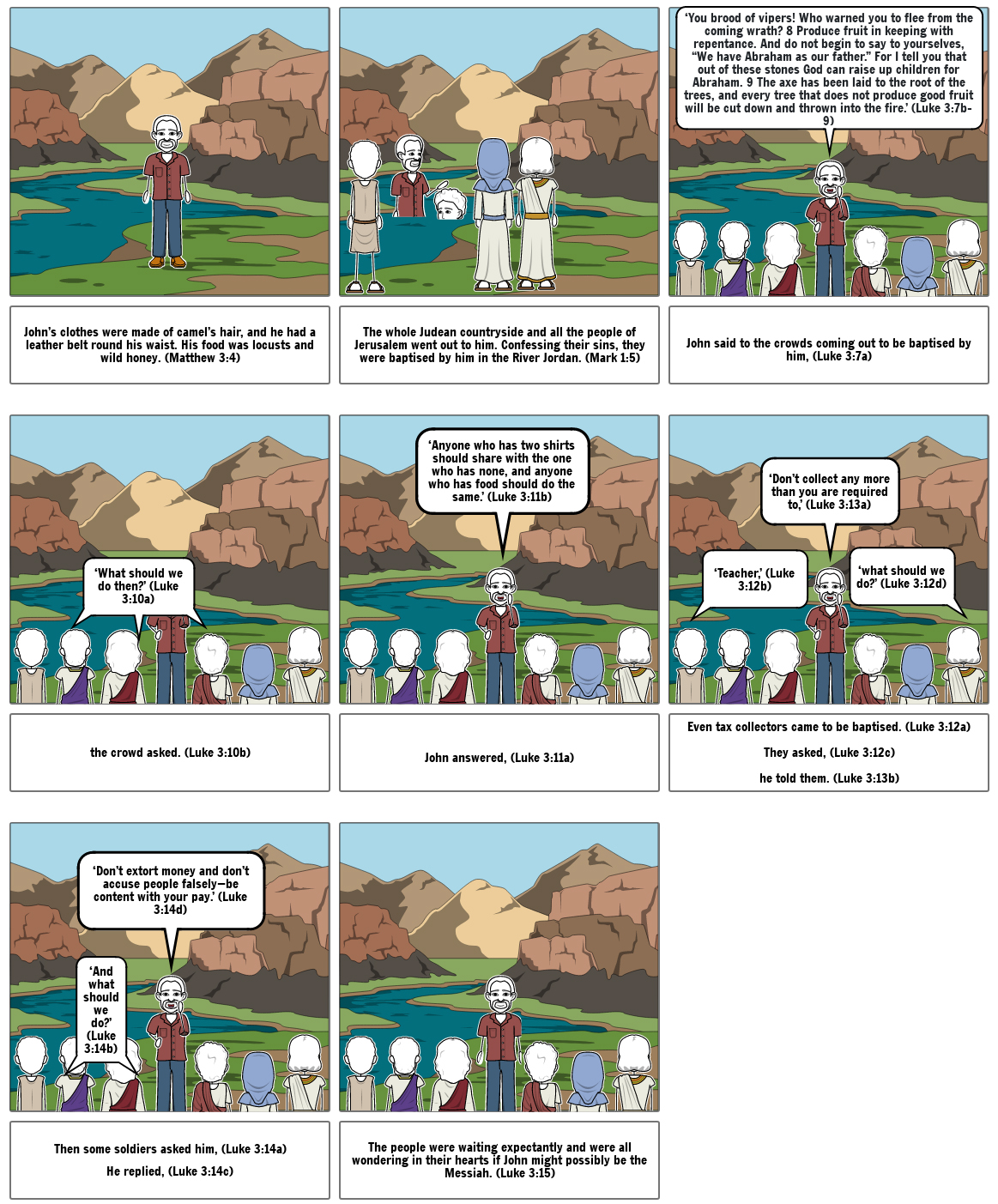
The message relevant to the above storyboard is https://comnc.org/john-the-baptists-message-and-practical-guidance/

The message relevant to the above storyboard is https://comnc.org/baptist-john-baptises-them-with-water-as-the-forerunner-of-the-messiah/
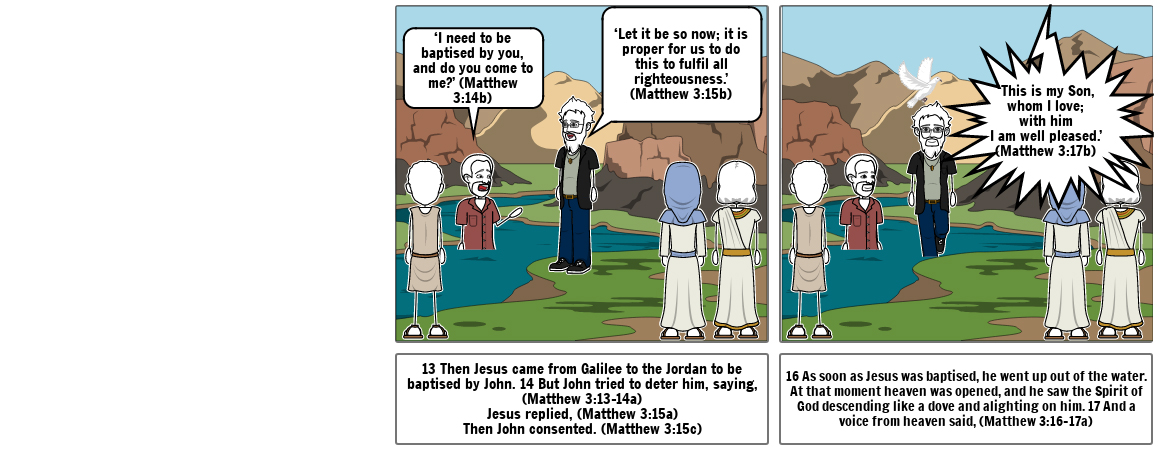
The message relevant to the above storyboard is https://comnc.org/the-baptism-of-jesus-and-the-testimony-of-god/
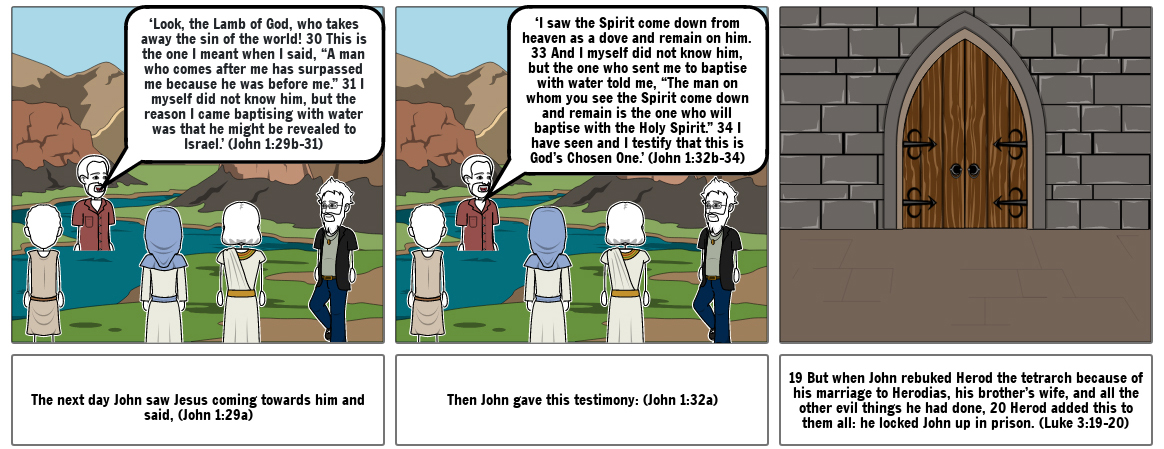
The message relevant to the above storyboard is https://comnc.org/jesus-the-lamb-of-god-gods-chosen-one/
Jesus, the Lamb of God, God’s Chosen One
John 1:29-34
29 The next day John saw Jesus coming towards him and said, ‘Look, the Lamb of God, who takes away the sin of the world! 30 This is the one I meant when I said, “A man who comes after me has surpassed me because he was before me.” 31 I myself did not know him, but the reason I came baptising with water was that he might be revealed to Israel.’
32 Then John gave this testimony: ‘I saw the Spirit come down from heaven as a dove and remain on him. 33 And I myself did not know him, but the one who sent me to baptise with water told me, “The man on whom you see the Spirit come down and remain is the one who will baptise with the Holy Spirit.” 34 I have seen and I testify that this is God’s Chosen One.’
I. John’s Testimony: Jesus is the Lamb of God (29-31)
When John the Baptist saw Jesus, he testified
“Look, the Lamb of God, who takes away the sin of the world!” (29)
Why is Jesus called ‘the Lamb of God’? ‘The Lamb’ represents ‘the Passover lamb’ (Exodus 12:21) sacrificed during the ‘Passover’ event written in Exodus 12:1-30. The Israelites put the blood of the lamb on the sides and tops of door-frames of the houses (Exodus 12:6-7, Exodus 12:21-22) and when God saw the blood, he ‘passed over’ them without striking them with the destructive plague (Exodus 12:12-13, Exodus 12:23).
In the Law, God let us forgiven by sacrificing an animal(s) (e.g., bull, sheep) without defect (e.g., Leviticus 4, 5, 7, 14).
Jesus (the Lamb of God) who was without sin (without defect) died for us to take our sin away! Because he received the punishment we deserve (Isaiah 53), we are forgiven when we believe him (Romans 10:9-13). He did this because he loves us. This is the good news of salvation for all humanity.
“A man who comes after me has surpassed me because he was before me.” (30) was mentioned in John 1:15.
‘John testified concerning him. He cried out, saying, “This is the one I spoke about when I said, “He who comes after me has surpassed me because he was before me.” ’ (John 1:15)
This John is Baptist (= Baptiser or Witness) John. He was an excellent prophet like Elijah. So, people could think he might be the Messiah. But, he was not the light, but a witness to the light (John 1:8), expressing himself as ‘the voice’ (John 1:23). John made it clear “Jesus is greater” which reason John told was that Jesus was ‘before’ him, even though he was born 6 months earlier than Jesus on the earth. We learn that it is important to know and testify the fact that the Word existed before the creation as written in John 1:1-14.
This is called the pre-existence of Christ. That is, Jesus was a pre-existent divine hypostasis (=the underlying state or underlying substance and is the fundamental reality that supports all else [3]) [2].
Regarding minimum preparation for witnessing as a believer, one may refer to 1 Peter 3:15. As a disciple, one may refer to Matthew 28:18-20.
See John 1:31.
I myself did not know him, but the reason I came baptising with water was that he might be revealed to Israel.’
The object of John’s baptism [4] includes
- “Preparing a people for the Lord” (Isaiah 40:3-5, Luke 3:4-6).
- “The Messiah might be revealed to Israel” (John 1:31).
Jesus was revealed as Messiah during the baptism in John 1:32-34.
II. John’s Testimony: Jesus is God’s Chosen One (32-34)
See John 1:32-34
32 Then John gave this testimony: ‘I saw the Spirit come down from heaven as a dove and remain on him. 33 And I myself did not know him, but the one who sent me to baptise with water told me, “The man on whom you see the Spirit come down and remain is the one who will baptise with the Holy Spirit.” 34 I have seen and I testify that this is God’s Chosen One.’
John the Baptist was kinsman of Jesus and born 6 months before Jesus. But John says “I myself did not know him” in John 1:31 and again John 1:33.
John’s ‘knowledge’ here was obtained via God’s revelation, which John heard (33) and saw (32, 34).
Some knowledge is given by God’s will & selection (Matthew 11:27).
… no one knows the Father except the Son and those to whom the Son chooses to reveal him.
When Peter said to Jesus, ‘You are the Messiah, the Son of the living God.’ in Matthew 16:16, Jesus said that this was revealed to Peter by His Father in heaven. See Matthew 16:17.
‘Blessed are you, Simon son of Jonah, for this was not revealed to you by flesh and blood, but by my Father in heaven.’
We can see a similar principle in John 1:12-13.
12 Yet to all who did receive him, to those who believed in his name, he gave the right to become children of God—13 children born not of natural descent, nor of human decision or a husband’s will, but born of God.
- natural descent (13a): physical birth [5]
- human decision (13b): self-determination [5]
- a husband’s will (13c): the choice of another person [5]
Finally, see John 1:34.
I have seen and I testify that this is God’s Chosen One.’
Here, ‘I have seen’ means that John saw “the Spirit come down and remain on Jesus” (32, 33).
The term “God’s Chosen One”, that indicates the Messiah, is written in Isaiah 42:1
‘Here is my servant, whom I uphold,
my chosen one in whom I delight;
I will put my Spirit on him,
and he will bring justice to the nations.
References
[1] The Holy Bible: New International Version (Anglicised Edition, 2011), Revised and updated edition. (London: Hodder & Stoughton, 2011).
[2] Wikipedia. Pre-existence of Christ.
[3] Wikipedia. hypostasis.
[4] John Peter Lange and Philip Schaff, A Commentary on the Holy Scriptures: John (Bellingham, WA: Logos Bible Software, 2008), 87.
[5] Gangel, K. O. (2000). John (Vol. 4, p. 12). Nashville, TN: Broadman & Holman Publishers.
The Baptism of Jesus and the Testimony of God
Matthew 3:13-17
Verses parallel to Matthew 3:13-17 are Mark 1:9-11, Luke 3:21-22, and John 1:29-34.
See Matthew 3:13-14.
13 Then Jesus came from Galilee to the Jordan to be baptised by John. 14 But John tried to deter him, saying, ‘I need to be baptised by you, and do you come to me?’
John knew Jesus personally and he knew that Jesus was more righteous than him [2]. So, he considered that Jesus should give him the baptism of repentance. So, he deterred Jesus (14).
However, John did not know Jesus as the Messiah until the revelation (John 1:33-34).
What was the response of Jesus? See Matthew 3:15.
Jesus replied, ‘Let it be so now; it is proper for us to do this to fulfil all righteousness.’ Then John consented.
“Jesus’ somewhat ambiguous reply seems to acknowledge the force of John’s logic but nevertheless requests baptism for different reasons. Jesus has not come to confess any sin but ‘to fulfil all righteousness.’ He has previously fulfilled specific prophecies as well as more general scriptural themes. Now he wishes to obey all the moral demands of God’s will.” [3]
“ ‘To fulfil all righteousness’ means to complete everything that forms part of a relationship of obedience to God. In so doing, Jesus identifies with and endorses John’s ministry as divinely ordained and his message as one to be heeded.” [3]
See Matthew 3:16–17.
16 As soon as Jesus was baptised, he went up out of the water. At that moment heaven was opened, and he saw the Spirit of God descending like a dove and alighting on him. 17 And a voice from heaven said, ‘This is my Son, whom I love; with him I am well pleased.’
The Father, the Son (17) and the Holy Spirit (16) appear in these verses. The verses relevant to the voice from heaven (17) are in Psalm 2:7 and Isaiah 42:1 among Psalm 2:1-12 and Isaiah 42:1-7 written about the Messiah.
“Nothing suggests that Jesus began a relationship with the Holy Spirit only at this point. Matthew 2:15 makes clear that Matthew views Jesus as God’s Son at least from infancy, while Matthew 1:23 views him as “God with us” from birth.” [3]
As in Psalm 2 (Royal Enthronement), v16-17 shows a formal instalment and commissioning [1]. Jesus’ baptism was ‘proper’ (15) as “God is initiating Jesus into the public phase of his ministry on earth.” [3]
Related to the event in v16-17, Jesus said in John 5:36-40.
John 5:36-40 (NIVUK): 36 ‘I have testimony weightier than that of John. For the works that the Father has given me to finish—the very works that I am doing—testify that the Father has sent me. 37 And the Father who sent me has himself testified concerning me. You have never heard his voice nor seen his form, 38 nor does his word dwell in you, for you do not believe the one he sent. 39 You study the Scriptures diligently because you think that in them you have eternal life. These are the very Scriptures that testify about me, 40 yet you refuse to come to me to have life.
(‘Testimonies about Jesus’ is written in John 5:31-47)
References
[1] The Holy Bible: New International Version (Anglicised Edition, 2011), Revised and updated edition. (London: Hodder & Stoughton, 2011), Mt 3:13–14.
[2] Did John the Baptist know Jesus
as the Messiah? Do Matt 3:14 and John 1:33 conflict? 05/04/2022]; Available from: https://bible.org/question/did-john-baptist-know-jesus-messiah-do-matt-314-and-john-133-conflict.
[3] Bloomberg, Craig L. The New American Commentary: Matthew