The Spirit’s Groanings and God’s Unbreakable Chain of Salvation
Romans 8:26–30 NLT
26 And the Holy Spirit helps us in our weakness. For example, we don’t know what God wants us to pray for. But the Holy Spirit prays for us with groanings that cannot be expressed in words. 27 And the Father who knows all hearts knows what the Spirit is saying, for the Spirit pleads for us believers in harmony with God’s own will. 28 And we know that God causes everything to work together for the good of those who love God and are called according to his purpose for them. 29 For God knew his people in advance, and he chose them to become like his Son, so that his Son would be the firstborn among many brothers and sisters. 30 And having chosen them, he called them to come to him. And having called them, he gave them right standing with himself. And having given them right standing, he gave them his glory.
Message
God’s children are glorified via suffering (Romans 8:15-17). But future glory far exceeds current suffering and so we wait patiently and confidently for what God has promised (Romans 8:18-25).
Then did God leave us alone while we are suffering and waiting for the glory?
I. The Spirit’s Presence and Help (26)
See verse 26.
26 And the Holy Spirit helps us in our weakness. For example, we don’t know what God wants us to pray for. But the Holy Spirit prays for us with groanings that cannot be expressed in words.
i. The Spirit is With Us
Jesus promised to send the Holy Spirit to His believers before He left (John 14:26, 15:26, 16:7).
-
- Comforter / Helper — He comes alongside believers to help and strengthen them.
John 14:16, 26 - Advocate / Counselor — He supports, guides, and represents God’s truth to us.
John 14:16; John 16:7 - Teacher — He teaches believers and reminds them of Jesus’ words.
John 14:26 - Guide into truth — He leads believers into truth and tells them about the future.
John 16:13 - Witness about Jesus — He testifies about Christ.
John 15:26 - Convicts the world — He exposes sin, righteousness, and judgment.
John 16:8–11 - Lives in believers — He dwells within God’s people.
John 14:17; 1 Corinthians 6:19 - Gives new spiritual life — We are born again through the Spirit.
John 3:5–8; Titus 3:5 - Gives power — He empowers believers to witness and serve God.
Acts 1:8 - Produces spiritual fruit — Love, joy, peace, patience, kindness, goodness, faithfulness, gentleness, and self-control.
Galatians 5:22–23 - Gives spiritual gifts — He gives different abilities for serving the church.
1 Corinthians 12:4–11 - Sanctifies believers — He works in us to make us holy and more like Christ.
2 Thessalonians 2:13; 1 Peter 1:2 - Leads believers — God’s children are led by the Spirit.
Romans 8:14 - Brings freedom — “Wherever the Spirit of the Lord is, there is freedom.”
2 Corinthians 3:17 - Seals believers — He is God’s seal showing that we belong to Him and a guarantee of our future inheritance.
Ephesians 1:13–14
- Comforter / Helper — He comes alongside believers to help and strengthen them.
ii. The Spirit Helps Us in Our Weakness
What is our weakness? For example, we don’t know what God wants us to pray for. But the Holy Spirit prays for us with groanings that cannot be expressed in words. Amen.
II. Perfect Intercession, Perfect Providence (27-28)
See verses 27-28.
27 And the Father who knows all hearts knows what the Spirit is saying, for the Spirit pleads for us believers in harmony with God’s own will. 28 And we know that God causes everything to work together for the good of those who love God and are called according to his purpose for them.
The Father knows all hearts and so He knows what the Holy Spirit is saying with groanings that cannot be expressed in words. The Holy Spirit pleads for us believers in harmony with God’s own will. God causes everything to work together for the good of those who love God and are called according to his purpose for them.
III. The Golden Chain of Salvation (29-30)
See verses 29-30.
29 For God knew his people in advance, and he chose them to become like his Son, so that his Son would be the firstborn among many brothers and sisters. 30 And having chosen them, he called them to come to him. And having called them, he gave them right standing with himself. And having given them right standing, he gave them his glory.
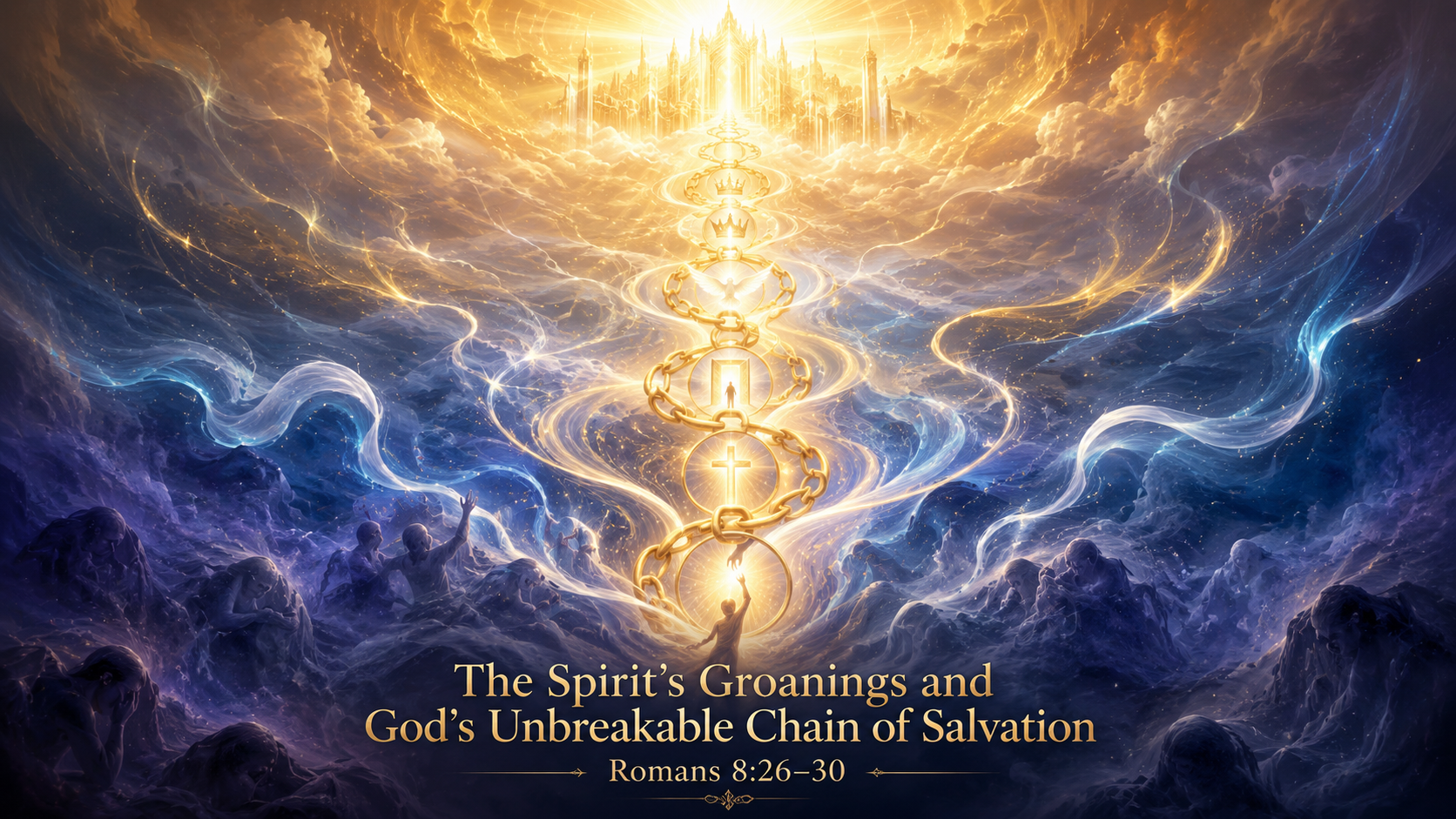
Foreknowledge: God knew his people in advance.
Predestination: God chose them to become like His Son, so that His Son would be the firstborn among many brothers and sisters. (29)
Calling: Having chosen them, He called them to come to Him.
Justification: Having called them, He gave them right standing with Himself.
Glorification: Having given them right standing, He gave them His glory. (30)
Groaning Now, Glory Later: The Hope That Sustains God’s Children
Romans 8:18–25 NLT
18 Yet what we suffer now is nothing compared to the glory he will reveal to us later. 19 For all creation is waiting eagerly for that future day when God will reveal who his children really are. 20 Against its will, all creation was subjected to God’s curse. But with eager hope, 21 the creation looks forward to the day when it will join God’s children in glorious freedom from death and decay. 22 For we know that all creation has been groaning as in the pains of childbirth right up to the present time. 23 And we believers also groan, even though we have the Holy Spirit within us as a foretaste of future glory, for we long for our bodies to be released from sin and suffering. We, too, wait with eager hope for the day when God will give us our full rights as his adopted children, including the new bodies he has promised us. 24 We were given this hope when we were saved. (If we already have something, we don’t need to hope for it. 25 But if we look forward to something we don’t yet have, we must wait patiently and confidently.)
Message
We are God’s children and heirs of His glory (Romans 8:15-17a-b NLT). But if we are to share His glory, we must also share His suffering (Romans 8:17c NLT).
I. Future Glory Far Exceeds Current Suffering (18)
See verse 18.
18 Yet what we suffer now is nothing compared to the glory he will reveal to us later.
It is like a woman in labor who forgets the pain of childbirth because of her joy that a child has been born into the world (John 16:21).
II. All Creation Waits, Hopes, and Groans (19-22)
All creation eagerly waits for God to reveal His children (19).
Creation was subjected to God’s curse, but it hopes to share in the glorious freedom of God’s children (20–21).
All creation groans like a woman in labor (22).
III. Believers Groan, Wait, and Hope (23-24)
We believers also groan, although the Holy Spirit gives us a foretaste of future glory.
We eagerly await our full adoption, including the redemption of our bodies (23).
We received this hope when we were saved. Hope looks forward to what we do not yet have (24).
IV. A Call for Patience and Confidence in Waiting (25)
Therefore, we wait patiently and confidently for what God has promised (25).
God’s Children Glorified via Suffering
Romans 8:15–17 NLT
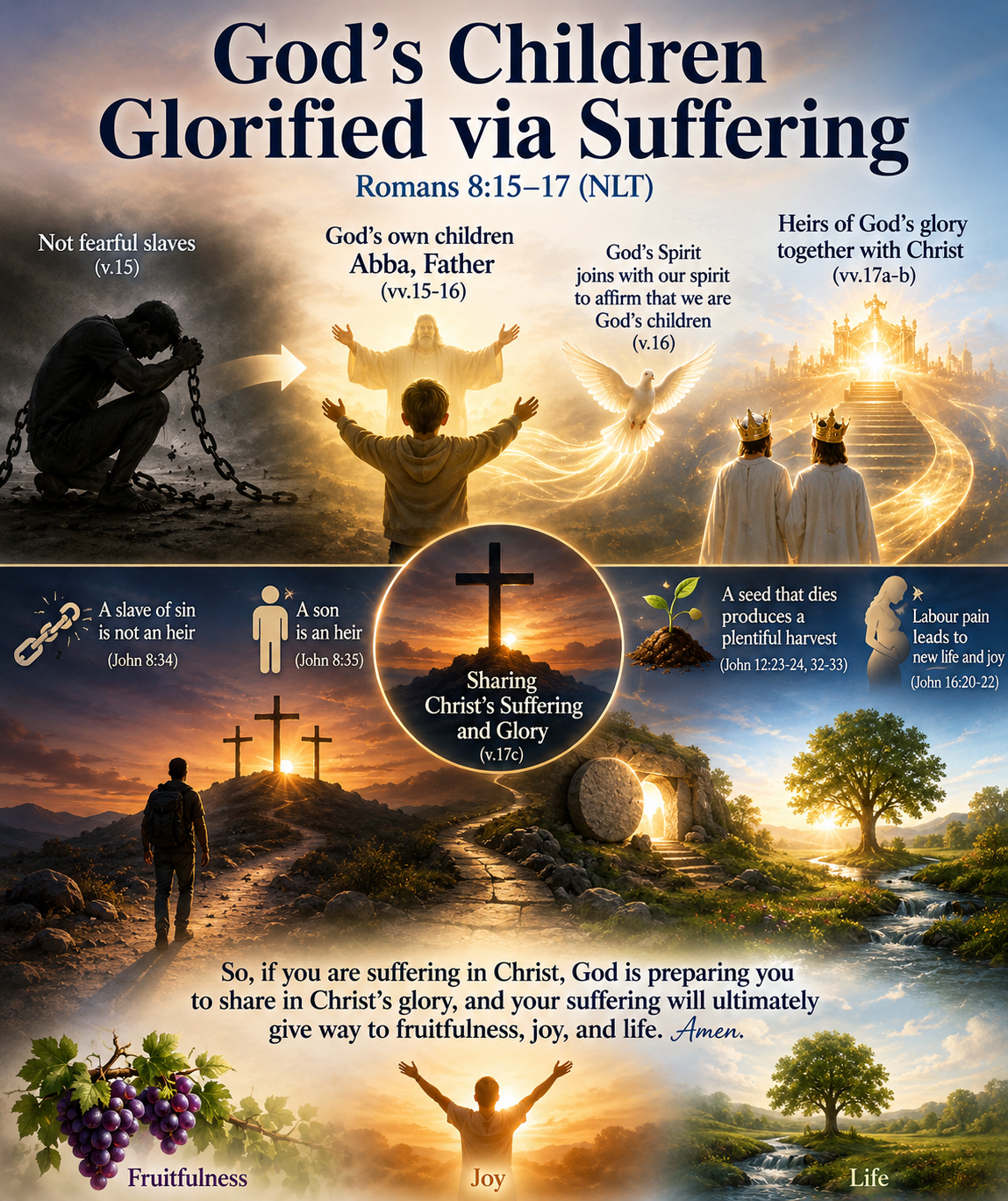
15 So you have not received a spirit that makes you fearful slaves. Instead, you received God’s Spirit when he adopted you as his own children. Now we call him, “Abba, Father.” 16 For his Spirit joins with our spirit to affirm that we are God’s children. 17 And since we are his children, we are his heirs. In fact, together with Christ we are heirs of God’s glory. But if we are to share his glory, we must also share his suffering.
Message
I. Not Fearful slaves But God’s Own Children (15-16)
All who are led by the Spirit of God are children of God (Romans 8:14 NLT). Then should we live like fearful slaves to carefully follow the Spirit? See verse 15.
15 So you have not received a spirit that makes you fearful slaves. Instead, you received God’s Spirit when he adopted you as his own children. Now we call him, “Abba, Father.”
God did not give us a spirit of slavery that produces fear (15a, 2 Timothy 1:7). We received God’s Spirit, who enabled us, as God’s adopted children, to call God our own dear Father—“Abba, Father.” (15b, Galatians 4:6-7). Here, “Abba” is an Aramaic word meaning “father.” It is because God’s Spirit joins with our spirit to affirm that we are God’s children (16).
II. God’s Children Are Heirs of His Glory (17a-b)
See verse 17a-b.
17a-b And since we are his children, we are his heirs. In fact, together with Christ we are heirs of God’s glory.
A similar verse to verse 17a-b is Galatians 4:7 NLT:
“Now you are no longer a slave but God’s own child. And since you are his child, God has made you his heir.”
Here, ‘a slave’ means ‘a slave of sin’ (John 8:34). A slave is not an heir, but a son is an heir (John 8:35). Together with Christ, we are heirs of God’s glory (17b)
III. Sharing Christ’s Suffering and Glory (17c)
But if we are to share His glory, we must also share His suffering (17c).
Jesus foretold His disciples about His crucifixion and resurrection (John 10-21), and He called both events part of the “Glorification” (John 12:23, 28, 13:31-32, 17:1).
Jesus taught the glory after the suffering through the metaphors of a seed that dies and produces a plentiful harvest (John 12:23-24, 32-33) and a woman suffering labour pain, then rejoicing at the birth of new life (John 16:20-22).
So, if you are suffering in Christ, God is preparing you to share in Christ’s glory, and your suffering will ultimately give way to fruitfulness, joy, and life. Amen.
No Obligation to the Flesh: Living as Children of God
Romans 8:10–14 NLT
10 And Christ lives within you, so even though your body will die because of sin, the Spirit gives you life because you have been made right with God. 11 The Spirit of God, who raised Jesus from the dead, lives in you. And just as God raised Christ Jesus from the dead, he will give life to your mortal bodies by this same Spirit living within you.
12 Therefore, dear brothers and sisters, you have no obligation to do what your sinful nature urges you to do. 13 For if you live by its dictates, you will die. But if through the power of the Spirit you put to death the deeds of your sinful nature, you will live. 14 For all who are led by the Spirit of God are children of God.
Message
I. The Spirit’s Control as the Mark of True Believers (Romans 8:1-9)
Let us recap what we studied last week:
Through Christ’s sacrifice, God fulfilled the law’s righteous requirement by punishing sin on our behalf so that we could be forgiven, enabling us to follow the Holy Spirit. Those who are dominated by the Holy Spirit think about things that please the Spirit. Letting the Spirit control our minds leads to life and peace. Being dominated by the sinful nature leads to sinful thoughts, followed by hostility toward God and death. (Romans 8:1-8 NLT)
If you have the Spirit of God living in you, you are not controlled by your sinful nature, but controlled by the Spirit. Those who do not have the Spirit of Christ living in them do not belong to him at all. (Romans 8:9 NLT)
II. The Indwelling Christ and the Spirit’s Life-Giving Power (10-11)
Today Paul continues after his above discussion. See verse 10.
10 And Christ lives within you, so even though your body will die because of sin, the Spirit gives you life because you have been made right with God.
How do we know whether Christ lives within you or not? Based on Romans 8:9 NLT, it depends on whether you are not controlled by your sinful nature but by the Spirit or not.
You can know whether you are controlled by your sinful nature by looking at your having sinful thoughts, or hostility toward God (Romans 8:5-8 NLT).
Then, why our body will still die? It is because our sinful nature is still in our body as long as our body is alive. This fact is shown in Paul’s confession in Romans 7:14-24 NLT. Let us read Romans 7:24 NLT:
24 Oh, what a miserable person I am! Who will free me from this life that is dominated by sin and death?
Because Christ lives within you, our spirit will live (10b) and our body also will be transformed and raised into a new heavenly body (1 Corinthians 15:51-53, 42-44 NLT, 10b).
See verse 11:
11 The Spirit of God, who raised Jesus from the dead, lives in you. And just as God raised Christ Jesus from the dead, he will give life to your mortal bodies by this same Spirit living within you.
Amen.
III. Freedom From the Flesh and the Call to Put Sin to Death (12-13)
See verse 12:
12 Therefore, dear brothers and sisters, you have no obligation to do what your sinful nature urges you to do.
Sin’s urges can make us feel as if we are obligated to respond to them. So, Paul says that we have “no obligation” to do so. Verse 12 helps us not to sin. Further Paul warns in verse 13a:
13a For if you live by its dictates, you will die.
This verse reminds us of Galatians 6:7–8a NLT:
7 Don’t be misled—you cannot mock the justice of God. You will always harvest what you plant. 8a Those who live only to satisfy their own sinful nature will harvest decay and death from that sinful nature.
What we must do instead is written in verse 13b:
13b But if through the power of the Spirit you put to death the deeds of your sinful nature, you will live.
Galatians 6:8b NLT also says,
8b But those who live to please the Spirit will harvest everlasting life from the Spirit.
IV. Spirit-Led Living as the Evidence of God’s Children (14)
Paul encourages us in verse 14:
14 For all who are led by the Spirit of God are children of God.
Amen.
No Condemnation, Life Through the Spirit
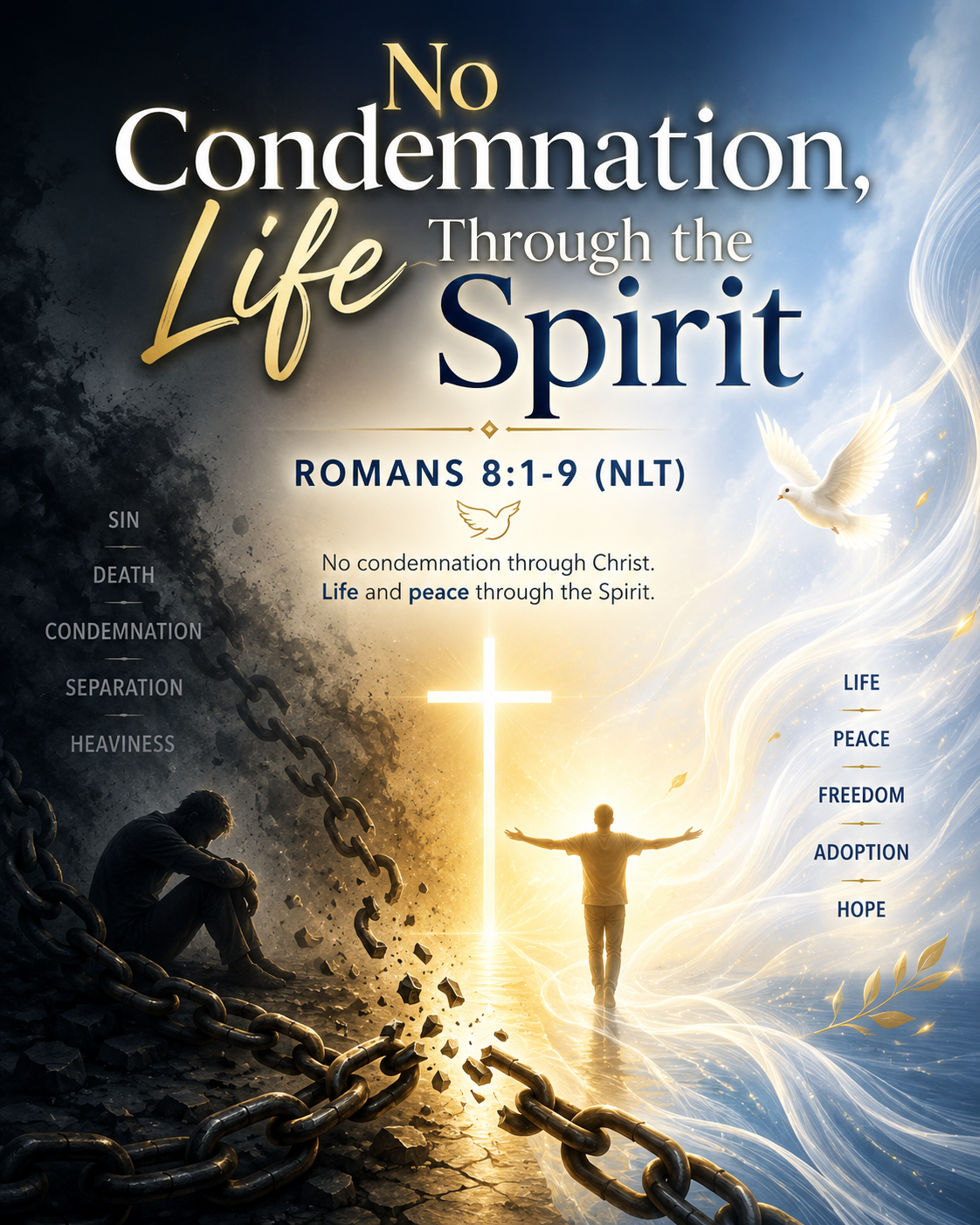
Romans 8:1-9 (NLT)
1 So now there is no condemnation for those who belong to Christ Jesus. 2 And because you belong to him, the power of the life-giving Spirit has freed you from the power of sin that leads to death. 3 The law of Moses was unable to save us because of the weakness of our sinful nature. So God did what the law could not do. He sent his own Son in a body like the bodies we sinners have. And in that body God declared an end to sin’s control over us by giving his Son as a sacrifice for our sins. 4 He did this so that the just requirement of the law would be fully satisfied for us, who no longer follow our sinful nature but instead follow the Spirit. 5 Those who are dominated by the sinful nature think about sinful things, but those who are controlled by the Holy Spirit think about things that please the Spirit. 6 So letting your sinful nature control your mind leads to death. But letting the Spirit control your mind leads to life and peace. 7 For the sinful nature is always hostile to God. It never did obey God’s laws, and it never will. 8 That’s why those who are still under the control of their sinful nature can never please God. 9 But you are not controlled by your sinful nature. You are controlled by the Spirit if you have the Spirit of God living in you. (And remember that those who do not have the Spirit of Christ living in them do not belong to him at all.)
Message
Paul confessed he was released from the law but still battling the flesh (Romans 7:14-24). But he thanked God that the answer is in Jesus Christ our Lord (Romans 7:25a). His situation is summarized in Romans 7:25b.
“So you see how it is: In my mind I really want to obey God’s law, but because of my sinful nature I am a slave to sin.”
I. No Condemnation Through Christ’s Sacrifice (1–4)
Today, Paul starts with the declaration in verse 1.
1 So now there is no condemnation for those who belong to Christ Jesus.
Despite of still battling their flesh or sinful nature, Paul declares there is no condemnation for those who belong to Christ Jesus. Here, whether they belong to Christ Jesus or not depends on whether the Spirit of Christ is living in them or not (9b).
Paul explains the reason of his declaration. See verse 2.
2 And because you belong to him, the power of the life-giving Spirit has freed you from the power of sin that leads to death.
The power of the life-giving Spirit has freed those who belong to Him from the power of sin that leads to death.
Paul gives more detailed explanations. See verses 3-4.
3 The law of Moses was unable to save us because of the weakness of our sinful nature. So God did what the law could not do. He sent his own Son in a body like the bodies we sinners have. And in that body God declared an end to sin’s control over us by giving his Son as a sacrifice for our sins. 4 He did this so that the just requirement of the law would be fully satisfied for us, who no longer follow our sinful nature but instead follow the Spirit.
The Son of God Jesus sacrificed for our sins to satisfy the Law’s requirement for forgiving us for our sins.
“no longer follow our sinful nature but instead follow the Spirit” (4b) is
- the result of the sacrifice, through which the Law’s righteous purpose is fulfilled in their lives.
- the way believers must continue to live.
II. Life and Mindset in the Spirit (5–9)
Whether they are dominated by the sinful nature or by the Holy Spirit is shown by whether they think about sinful things or things that please the Spirit (5). You are responsible for letting which one controls your mind. Letting your sinful nature control your mind leads to death, but letting the Spirit control your mind leads to life and peace (6).
Because the sinful nature is always hostile to God, it never did obey God’s laws, and it never will (7). That’s why those who are still under the control of their sinful nature can never please God (8).
Paul simply confirms, “If you have the Spirit of God living in you, you are not controlled by your sinful nature but by the Spirit.” (9a) Paul reminds them that those who do not have the Spirit of Christ living in them do not belong to him at all (9b).
Released from the Law, Still Battling the Flesh
Romans 7:14-25 NLT
14 So the trouble is not with the law, for it is spiritual and good. The trouble is with me, for I am all too human, a slave to sin. 15 I don’t really understand myself, for I want to do what is right, but I don’t do it. Instead, I do what I hate. 16 But if I know that what I am doing is wrong, this shows that I agree that the law is good. 17 So I am not the one doing wrong; it is sin living in me that does it. 18 And I know that nothing good lives in me, that is, in my sinful nature. I want to do what is right, but I can’t. 19 I want to do what is good, but I don’t. I don’t want to do what is wrong, but I do it anyway. 20 But if I do what I don’t want to do, I am not really the one doing wrong; it is sin living in me that does it. 21 I have discovered this principle of life—that when I want to do what is right, I inevitably do what is wrong. 22 I love God’s law with all my heart. 23 But there is another power within me that is at war with my mind. This power makes me a slave to the sin that is still within me. 24 Oh, what a miserable person I am! Who will free me from this life that is dominated by sin and death? 25 Thank God! The answer is in Jesus Christ our Lord. So you see how it is: In my mind I really want to obey God’s law, but because of my sinful nature I am a slave to sin.
Message
Let us briefly review what we learned earlier.
When Christ died for our sins on the cross, our old selves died with Him (Romans 6:3-8). This death of our old selves put an end to our relationship with sin and the law (Romans 6:6-7, 7:4, 6). When Christ was raised to life, we were united with Him in the new life to God (Romans 6:4-5, 8, 10-11, 7:4).
Romans 7:4-6 NLT summarizes these key points:
4 So, my dear brothers and sisters, this is the point: You died to the power of the law when you died with Christ. And now you are united with the one who was raised from the dead. As a result, we can produce a harvest of good deeds for God. 5 When we were controlled by our old nature, sinful desires were at work within us, and the law aroused these evil desires that produced a harvest of sinful deeds, resulting in death. 6 But now we have been released from the law, for we died to it and are no longer captive to its power. Now we can serve God, not in the old way of obeying the letter of the law, but in the new way of living in the Spirit.
Last week, we learned that God’s law reveals our sin —How sin uses God’s good commandments for evil (Romans 7:7-14 NLT).
Today Paul repeats what he had already said in Romans 7:12-13a NLT. See verse 14a.
14a So the trouble is not with the law, for it is spiritual and good.
Paul says how terrible sin really is (Romans 7:13b) and the trouble is with him, for he is all too human, a slave to sin (Romans 7:14b).
Paul confesses in verse 15:
15 I don’t really understand myself, for I want to do what is right, but I don’t do it. Instead, I do what I hate.
Through this experience, Paul says the law is good because it teaches him that he is doing wrong but it is not him but sin living in him that does wrong (16, 17). Paul declares “Nothing good lives in me.”, which he calls ‘his sinful nature’ (18a).
Due to the sinful nature in him,
- He wants to do what is right, but he can’t (18b).
- He wants to do what is good, but he doesn’t (19a).
- He doesn’t want to do what is wrong, but he does it anyway (19b).
In verse 20, he repeats what he said in verses 16 and 17:
20 But if I do what I don’t want to do, I am not really the one doing wrong; it is sin living in me that does it.
Based on the above, Paul has discovered this principle of life (21a):
- when I want to do what is right,
- I inevitably do what is wrong (21b).
- I love God’s law with all my heart (22).
- But there is another power within me that is at war with my mind (23a). This power makes me a slave to the sin that is still within me (23b).
Therefore, Paul cries out in verse 24, “Oh, what a miserable person I am! Who will free me from this life that is dominated by sin and death?”
But he thanks God because the answer is in Jesus Christ our Lord (25a).
Paul then summarizes his predicament: In his mind he really wants to obey God’s law, but because of his sinful nature he is a slave to sin (25b).
Next week, we will joyfully continue to discover how the answer is found in Jesus Christ our Lord.
God’s Law Reveals Our Sin
How Sin Uses God’s Good Commandments for Evil
Romans 7:7-13 NLT
God’s Law Reveals Our Sin
7 Well then, am I suggesting that the law of God is sinful? Of course not! In fact, it was the law that showed me my sin. I would never have known that coveting is wrong if the law had not said, “You must not covet.” 8 But sin used this command to arouse all kinds of covetous desires within me! If there were no law, sin would not have that power. 9 At one time I lived without understanding the law. But when I learned the command not to covet, for instance, the power of sin came to life, 10 and I died. So I discovered that the law’s commands, which were supposed to bring life, brought spiritual death instead. 11 Sin took advantage of those commands and deceived me; it used the commands to kill me. 12 But still, the law itself is holy, and its commands are holy and right and good. 13 But how can that be? Did the law, which is good, cause my death? Of course not! Sin used what was good to bring about my condemnation to death. So we can see how terrible sin really is. It uses God’s good commands for its own evil purposes.
Last week, we learned that
- We died to the power of the law when we died with Christ (Romans 7:4 NLT).
- When we were controlled by our old nature, sinful desires were at work within us, and the law aroused these evil desires that produced a harvest of sinful deeds, resulting in death (Romans 7:5 NLT).
- Now that we have been released from the law —for we died to it and are no longer captive to its power—we can serve God, not in the old way of obeying the letter of the law, but in the new way of living in the Spirit (Romans 7:6 NLT).
Today, Paul asks a question. See verse 7a.
7a Well then, am I suggesting that the law of God is sinful?
He answers in verse 7b.
7b Of course not! In fact, it was the law that showed me my sin. I would never have known that coveting is wrong if the law had not said, “You must not covet.”
The law teaches us what sin is (7b) and how sinful we are (Romans 3:20b). The law itself is holy, and its commands are holy and right and good (12).
However, Paul explains how sin uses the law to arouse our sinful desires. For example, sin uses the command “You must not covet” (Exodus 20:17, Deuteronomy 5:21) to arouse all kinds of covetous desires within us (8a). If there were no law, sin would not have that power (8b). Paul lived without understanding or knowing the law but when he learned the command not to covet, for instance, the power of sin came to life (9), and his sense of innocence died, and he discovered that the law’s commands —commands that were supposed to bring life—brought spiritual death instead (10). So Paul says in verse 11.
11 Sin took advantage of those commands and deceived me; it used the commands to kill me.
Again, still the law itself is holy, and its commands are holy and right and good (12). So Paul asks another question. See verse 13a.
13a But how can that be? Did the law, which is good, cause my death?
Paul answers in verse 13b.
13b Of course not! Sin used what was good to bring about my condemnation to death.
Paul concludes in 13c.
13c So we can see how terrible sin really is. It uses God’s good commands for its own evil purposes.
Serving God in the New Way of the Spirit
Romans 7:1-6 (NLT)
1 Now, dear brothers and sisters—you who are familiar with the law—don’t you know that the law applies only while a person is living? 2 For example, when a woman marries, the law binds her to her husband as long as he is alive. But if he dies, the laws of marriage no longer apply to her. 3 So while her husband is alive, she would be committing adultery if she married another man. But if her husband dies, she is free from that law and does not commit adultery when she remarries. 4 So, my dear brothers and sisters, this is the point: You died to the power of the law when you died with Christ. And now you are united with the one who was raised from the dead. As a result, we can produce a harvest of good deeds for God. 5 When we were controlled by our old nature, sinful desires were at work within us, and the law aroused these evil desires that produced a harvest of sinful deeds, resulting in death. 6 But now we have been released from the law, for we died to it and are no longer captive to its power. Now we can serve God, not in the old way of obeying the letter of the law, but in the new way of living in the Spirit.
Message
The law applies only while a person is living (1). For example, when a woman marries, the law binds her to her husband as long as he is alive (2a) But if he dies, the laws of marriage no longer apply to her (2b). So, while her husband is alive, she would be committing adultery if she married another man (3a) But if her husband dies, she is free from that law and does not commit adultery when she marries (3b).
The point is that we died to the power of the law when we died with Christ, and now we are united with the one who was raised from the dead (4a). As a result, we can produce a harvest of good deeds for God (4b). When we were controlled by our old nature, sinful desires were at work within us, and the law aroused these evil desires that produced a harvest of sinful deeds, resulting in death (5). But now we have been released from the law, for we died to it and are no longer captive to its power (6a). Now we can serve God, not in the old way of obeying the letter of the law, but in the new way of living in the Spirit (6b).
Amen.
From Slaves to Sin to Servants of God
Romans 6:19-23 NLT
19 Because of the weakness of your human nature, I am using the illustration of slavery to help you understand all this. Previously, you let yourselves be slaves to impurity and lawlessness, which led ever deeper into sin. Now you must give yourselves to be slaves to righteous living so that you will become holy. 20 When you were slaves to sin, you were free from the obligation to do right. 21 And what was the result? You are now ashamed of the things you used to do, things that end in eternal doom. 22 But now you are free from the power of sin and have become slaves of God. Now you do those things that lead to holiness and result in eternal life. 23 For the wages of sin is death, but the free gift of God is eternal life through Christ Jesus our Lord.
Message
I. Recap: What We Have Learned So Far
Let’s briefly recap what we have learned:
After the first man Adam sinned, his family was banned from the Garden of Eden where the Tree of Life was. As a result, everyone born on the earth eventually died. Since the second Adam Jesus Christ obeyed God and sacrificed for our sin, God’s grace and His gift of righteousness became available for all who receive it and they can live in triumph over sin and death through Jesus Christ. (See Romans 5:12-21)
When we believed Jesus Christ (and were baptised), we were united with Him in His death and set free from the power of sin. So, we will also be raised to life as He was. We should consider ourselves to be dead to the power of sin and alive to God through Christ Jesus. (See Romans 6:1-11)
We were set free from the slavery to sin to serve righteousness. We live under the freedom of God’s grace, which set us free from the law. We have become slaves to righteous living. (See Romans 6:12-18)
II. Today’s Passage (19-23)
The Roman world understood slavery: a slave belongs to a master and obeys that master. So, Paul uses that familiar image to explain a spiritual truth (19a). See 19b.
19b Previously, you let yourselves be slaves to impurity and lawlessness, which led ever deeper into sin. Now you must give yourselves to be slaves to righteous living so that you will become holy.
Those who are slaves to sin do not have the obligation to do right (20), which results in shame and eternal judgment (21). Now, see verse 22.
22 But now you are free from the power of sin and have become slaves of God. Now you do those things that lead to holiness and result in eternal life.
Paul uses the fact in verses 20 and 21 to contrast and highlight that now we, slaves to righteous living (Romans 6:18, 19) do have the obligation to do right. And the righteous deeds lead to holiness and result in eternal life (22b).
See verse 23.
23 For the wages of sin is death, but the free gift of God is eternal life through Christ Jesus our Lord.
The structure of Romans 6:19–23 shows a repeating pattern:
| 19a | The illustration of slavery to help you understand all this | |
| 19b | slaves to impurity and lawlessness led into | sin |
| slaves to righteous living lead to | holiness | |
| 20 | slaves to sin had no obligation to do right | |
| 21 | results: | shame |
| eternal doom | ||
| 22 | slaves of God lead to | holiness |
| result in | eternal life | |
| 23 | the wages of sin is | death |
| the free gift of God is | eternal life through Christ Jesus | |
That is, sin and holiness in verse 19 are repeated as shame in verse 21 and holiness in verse 22; eternal doom in verse 21 and eternal life in verse 22 are finally summarized in verse 23 as death and eternal life.
Set Free to Serve Righteousness
Romans 6:12 – 18 (NLT)
12 Do not let sin control the way you live; do not give in to sinful desires. 13 Do not let any part of your body become an instrument of evil to serve sin. Instead, give yourselves completely to God, for you were dead, but now you have new life. So use your whole body as an instrument to do what is right for the glory of God. 14 Sin is no longer your master, for you no longer live under the requirements of the law. Instead, you live under the freedom of God’s grace. 15 Well then, since God’s grace has set us free from the law, does that mean we can go on sinning? Of course not! 16 Don’t you realize that you become the slave of whatever you choose to obey? You can be a slave to sin, which leads to death, or you can choose to obey God, which leads to righteous living. 17 Thank God! Once you were slaves of sin, but now you wholeheartedly obey this teaching we have given you. 18 Now you are free from your slavery to sin, and you have become slaves to righteous living.
Message
To understand today’s passage, let us briefly recap what we studied last week:
We have been united with Christ in His death (Romans 6:5a) and resurrection (Romans 6:5b). When Christ died, He died once to break the power of sin. But now that He lives, He lives for the glory of God (Romans 6:10). We should consider ourselves to be dead to the power of sin and alive to God through Christ Jesus (Romans 6:11).
I. Our New Life in Christ Demands a New Way of Living (12–13)
We were dead with Christ but now we have new life in Christ (13c). Therefore,
- Do not let sin control the way you live (12a)
- Do not give in to sinful desires (12b)
- Do not let any part of your body become an instrument of evil to serve sin (13a).
- Instead, give yourselves completely to God (13b)
- Use your whole body as an instrument to do what is right for the glory of God (13d).
II. Grace Has Changed Our Master (14)
Paul explains our new reality. See verse 14:
14 Sin is no longer your master, for you no longer live under the requirements of the law. Instead, you live under the freedom of God’s grace.
- Sin is no longer our master
- We are no longer under law
- We now live under the freedom of God’s grace
III. Grace Is Not Permission to Sin (15)
Based on this, Paul confronts the false conclusion:
15a Well then, since God’s grace has set us free from the law, does that mean we can go on sinning?
The answer is:
Of course not! (15b)
IV. You Become a Slave to Whatever You Obey (16)
Paul teaches in verse 16:
16 Don’t you realize that you become the slave of whatever you choose to obey? You can be a slave to sin, which leads to death, or you can choose to obey God, which leads to righteous living.
Paul gives a spiritual principle:
- Obey sin → slavery → death
- Obey God → slavery → righteous living
There is no neutral ground. Every choice of obedience reveals our true master.
V. God Has Freed Us to Wholehearted Obedience (17–18)
See verses 17-18.
17 Thank God! Once you were slaves of sin, but now you wholeheartedly obey this teaching we have given you. 18 Now you are free from your slavery to sin, and you have become slaves to righteous living.
Because Christ has saved us and set us free from slavery to sin, we must actively choose to obey God and offer ourselves to Him. This obedience (17) shows our new life in Christ and leads to righteous living (18).