Do Not Judge Others — God Alone Is the Judge
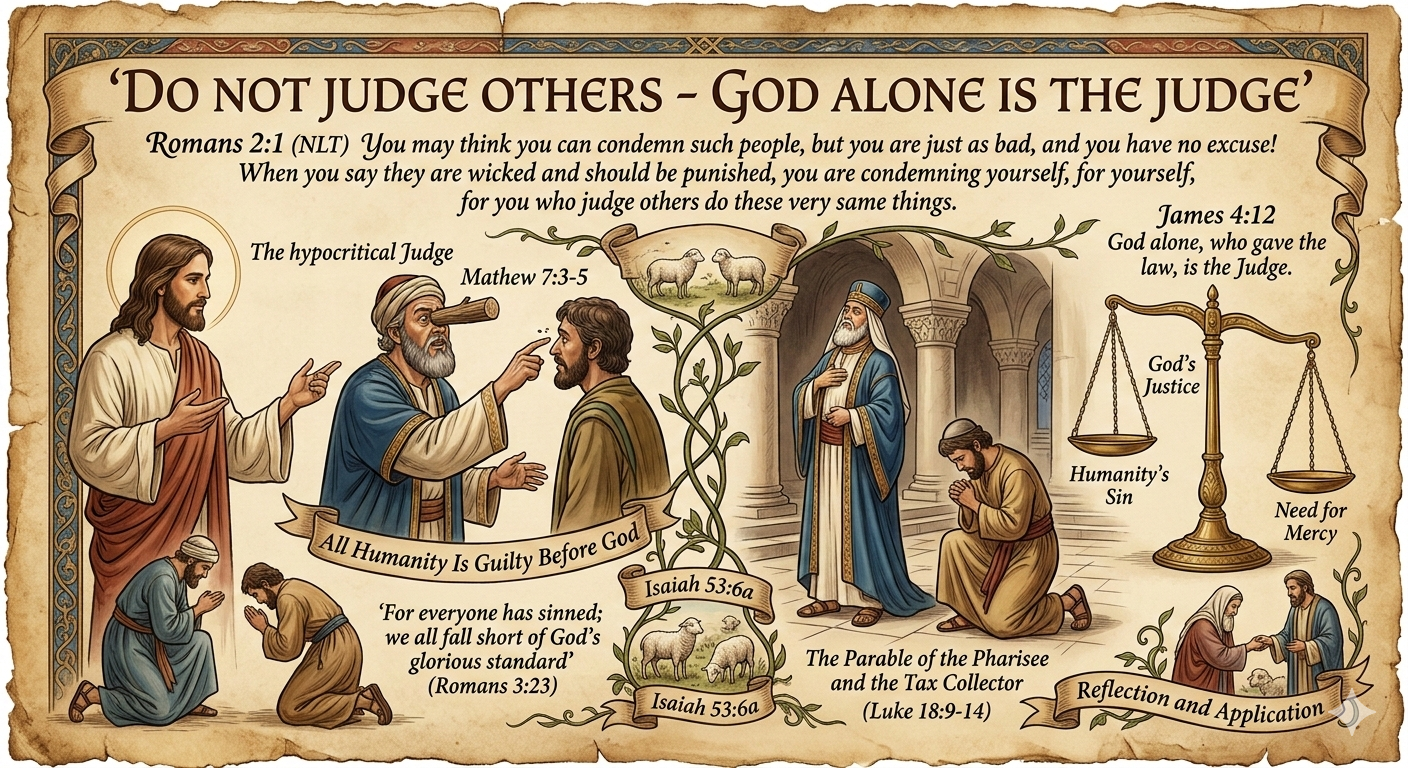
Romans 2:1 (NLT)
You may think you can condemn such people, but you are just as bad, and you have no excuse! When you say they are wicked and should be punished, you are condemning yourself, for you who judge others do these very same things.
Message
I. Introduction and Context
See verse 1.
You may think you can condemn such people, but you are just as bad, and you have no excuse! When you say they are wicked and should be punished, you are condemning yourself, for you who judge others do these very same things.
We have just finished studying Romans 1:1-32 last week. Paul declared in Romans 1:32 (NLT):
They know God’s justice requires that those who do these things deserve to die, yet they do them anyway. Worse yet, they encourage others to do them, too.
This verse might have reminded the reader of the evil people who had hurt him and made him angry. However, Paul warns such a reader in verse 1a.
“You may think you can condemn such people,”
The basis for this warning appears in verse 1b.
“but you are just as bad, and you have no excuse!”
II. All Humanity Is Guilty Before God
Without knowing who the reader is, Paul considers him just as bad. This reminds us of relevant Bible verses below.
- Jesus called the entire generation, “An evil and adulterous generation” in Matthew 12:38-39, 16:1-4.
- James called everyone, “You adulterers!” in James 4:4 (NLT).
- David wrote, “But no, all have turned away; all have become corrupt. No one does good, not a single one! (Psalm 14:3 NLT; see also Romans 3:12)
- Isaiah prophesied, “All of us, like sheep, have strayed away. We have left God’s paths to follow our own.” (Isaiah 53:6a NLT).
- Paul declared, “For everyone has sinned; we all fall short of God’s glorious standard.” in Romans 3:23 NLT.
III The Danger of Judging Others
See verse 1c.
“When you say they are wicked and should be punished, you are condemning yourself, for you who judge others do these very same things.”
This aligns with what Jesus taught in Matthew 7:1-5 NLT.
1 “Do not judge others, and you will not be judged. 2 For you will be treated as you treat others. The standard you use in judging is the standard by which you will be judged.
3 “And why worry about a speck in your friend’s eye when you have a log in your own? 4 How can you think of saying to your friend, ‘Let me help you get rid of that speck in your eye,’ when you can’t see past the log in your own eye? 5 Hypocrite! First get rid of the log in your own eye; then you will see well enough to deal with the speck in your friend’s eye.
IV. God Alone Is the Judge
James taught a similar principle in James 4:11-12 NLT. Let us learn that we are not lawgivers or judges, so we shouldn’t criticize and judge others. Instead, our job is to obey the law.
11 Don’t speak evil against each other, dear brothers and sisters. If you criticize and judge each other, then you are criticizing and judging God’s law. But your job is to obey the law, not to judge whether it applies to you. 12 God alone, who gave the law, is the Judge. He alone has the power to save or to destroy. So what right do you have to judge your neighbor?
V. The Parable of the Pharisee and the Tax Collector
Let’s learn a similar principle through the Parable of the Pharisee and the Tax Collector (Luke 18:9-14).
In this parable, the Pharisee is a religious man who was doing a lot of things for God but relied on his own self-righteousness based on his religious life. He thanked God that he was not like the tax collector! (Luke 18:11)
He did not ask God for mercy or forgiveness, so, he did not receive it.
On the other hand, the tax collector was not as religious but was humble before God.
He asked God to have mercy on him as a sinner. As a result, he received God’s mercy and forgiveness.
VI. Reminder for Believers
Finally, let us read Titus 3:2-5 (NLT) which gently teaches believers the above principle and reminds them of their past spiritual condition as unbelievers.
2 They must not slander anyone and must avoid quarreling. Instead, they should be gentle and show true humility to everyone.
3 Once we, too, were foolish and disobedient. We were misled and became slaves to many lusts and pleasures. Our lives were full of evil and envy, and we hated each other.
VII. Reflection and Application
This passage reminds us that no one is righteous on their own. We often notice the faults of others while ignoring our own. But God calls us to humility and self-examination rather than judgment.
When we remember that we, too, have received mercy, we learn to treat others with gentleness and patience.
Instead of condemning, we are to reflect God’s kindness — a kindness that leads people to repentance.
Let us therefore examine our own hearts, confess where pride and judgment remain, and ask God to help us see others through His eyes — with compassion, mercy, and truth.