When Human Reasoning Tries to Justify Sin
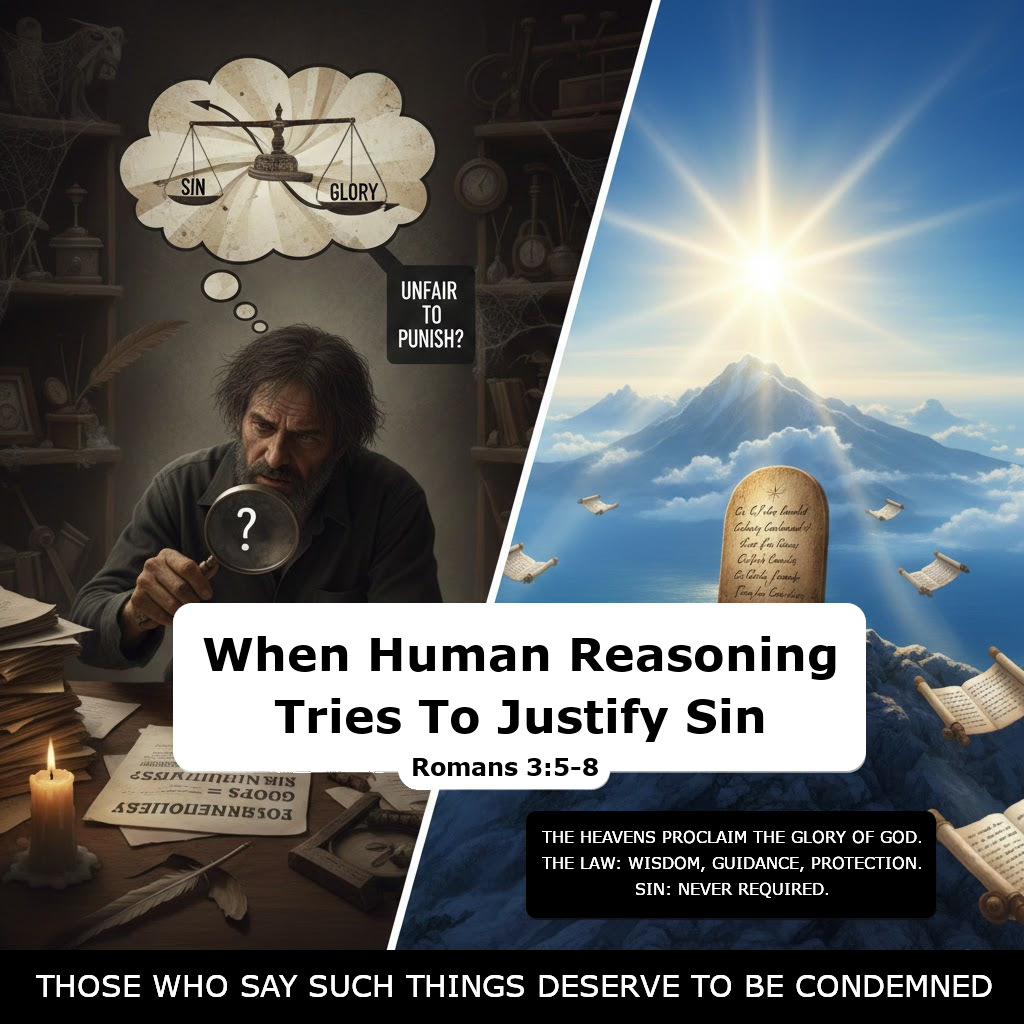
Romans 3:5–8 (NLT)
5 “But,” some might say, “our sinfulness serves a good purpose, for it helps people see how righteous God is. Isn’t it unfair, then, for him to punish us?” (This is merely a human point of view.) 6 Of course not! If God were not entirely fair, how would he be qualified to judge the world? 7 “But,” someone might still argue, “how can God condemn me as a sinner if my dishonesty highlights his truthfulness and brings him more glory?” 8 And some people even slander us by claiming that we say, “The more we sin, the better it is!” Those who say such things deserve to be condemned.
Message
I. A Question From Mere A Human Point of View (5)
Paul has established that human unfaithfulness does not nullify God’s faithfulness (Romans 3:3-4). Paul now confronts a dangerous human objection that attempts to turn God’s righteousness into a justification for sin. See verse 5.
5 “But,” some might say, “our sinfulness serves a good purpose, for it helps people see how righteous God is. Isn’t it unfair, then, for him to punish us?” (This is merely a human point of view.)
In Paul’s example, some say, “Our sinfulness helps people see how righteous God is.” (5a) This statement expresses as if our sin is ‘necessary’ for God’s glory. They continue to say, “Isn’t it unfair, then, for him to punish us?” (5b)
II. God’s Glory Is Revealed Without Our Sin (Romans 1:20, Psalm 19:1-14)
But our sin is not necessary for God to reveal His glory.
Romans 1:20 (NLT) says,
20 For ever since the world was created, people have seen the earth and sky. Through everything God made, they can clearly see his invisible qualities—his eternal power and divine nature. So they have no excuse for not knowing God.
According to Romans 1:20 (NLT), God’s creation itself testifies about God. We can know and experience God’s glory by observing what He has made.
Psalm 19:1-6 (NLT) reinforces this truth:
“The heavens proclaim the glory of God. The skies display his craftsmanship.”
The heavens do not require human sin to proclaim God’s glory. They speak continuously without a sound or word (Psalm 19:2-3a) —yet their message reaches the entire world (Psalm 19:3b-4a NLT). The radiant sun moves across the sky, and nothing is hidden from its heat (Psalm 19:4b-6)
Psalm 19:7-14 then shifts from creation to God’s law. See Psalm 19:13 (NLT).
“Keep your servant from deliberate sins! Don’t let them control me. Then I will be free of guilt and innocent of great sin.”
We learn what is right by meditating on God’s law—whether written in Scripture (Romans 3:2) or written on our hearts (Romans 2:15). God’s revelation through creation and His law guides us toward righteousness; sin is never required for God to be known or glorified.
When we see the sun shining in the sky, let us remember that God gave His law for our good just as surely as He gave us the sun. The sun brings warmth, light, and life; God’s law brings wisdom, guidance, and protection. To grasp this truth more deeply, take time to read Psalm 19—or revisit Section II of this message.
III. Paul’s Conclusion (6-8)
Paul declares in verse 6 that God is fair in judging everyone. In verse 7, Paul explains that an individual might raise the same argument that some raise in verse 5. The argument is this: a person’s dishonesty highlights God’s truthfulness, and as a result, his sin appears to bring more glory to God. Therefore, he concludes that God should not judge him.
Paul shows that this human way of reasoning leads directly to the claim in verse 8a:
“And some people even slander us by claiming that we say, ‘The more we sin, the better it is!’”
Paul then gives his conclusion in verse 8b:
“Those who say such things deserve to be condemned.”
Paul warns that thinking sin benefits God or should be overlooked is wrong, and those who say such things are rightly judged by God.